The quietest marriages in the room aren't always the happiest ones — sometimes they're the ones where someone stopped trying to be known years ago.
Relationship researchers keep running into a finding that complicates the standard story about long marriages. Couples in their late sixties and seventies often report higher marital satisfaction and fight less than they did in earlier decades. The conventional read is that they've softened, figured it out, arrived at something like harmony. But when you look closer at what's actually happening inside those quieter households, a different possibility keeps surfacing. Some of those couples aren't more peaceful. They've just stopped trying to be understood by the person sitting across the table, and from the outside that looks exactly like contentment.
I spent thirty-two years teaching teenagers how to read Shakespeare, and one of the first things I taught them was that silence onstage meant something. A character who stops speaking to another character isn't calmer. They've made a decision, and the audience is supposed to notice. Somewhere between the classroom and real life, we agreed to forget this, especially when it comes to the long marriages we watch from across a restaurant or a church pew, where two people sit without speaking and we tell ourselves they've simply run out of things to say because they know each other so well.
Most of us were taught that the arc of a good marriage bends toward peace. You fight hard in your thirties, negotiate through your forties, soften in your fifties, and by the time you hit your late sixties you're supposed to have arrived at harmony. What the research keeps quietly suggesting is something else. Many of those couples haven't figured anything out. They've just stopped trying.
What the outside can't see
There's a concept in couples research called the demand-withdraw pattern, where one partner pushes for connection or resolution and the other pulls away. For years, psychologists treated it as a problem stage, something couples pass through on their way to either repair or rupture. What research on conflict in long-term relationships has shown is that the pattern doesn't always resolve. Sometimes it calcifies. The demanding partner stops demanding. The withdrawing partner stops needing to withdraw because there's nothing left to withdraw from. The house goes quiet.
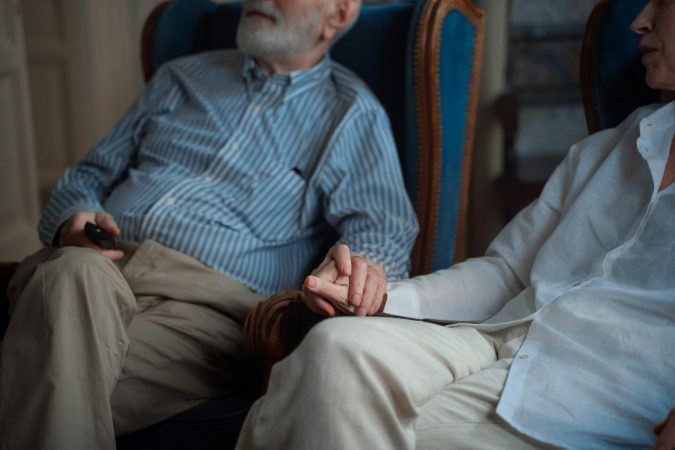
From the outside, this looks exactly like contentment. Two people moving around a kitchen without friction. One pouring coffee, the other reading the paper. No raised voices, no slammed doors. A neighbor might look in the window and think, that's what I want when I'm their age.
What the neighbor can't see is that one of them decided, somewhere around sixty-four, that explaining herself wasn't worth it anymore. Not because she'd been defeated, exactly. Because she'd run the math. How many years left. How many times she'd already said the same thing. How little had changed. At some point the cost of being misunderstood became lower than the cost of trying to be understood again.

The difference between peace and surrender
Some researchers who study well-being in older adults draw a sharp line between active contentment and passive acceptance. Genuine contentment has a texture to it. Engagement, curiosity, a continued interest in the other person as a moving target rather than a settled fact. Passive acceptance has a different texture. It looks the same from across the room, but inside the person living it, something has gone still.
I watched my own parents do this in their seventies. My father would tell the same seven stories he'd been telling my entire life, and my mother would nod at the parts where nodding was required. I used to think this was sweet. The long-married shorthand, the comfort of the familiar. It took me until my fifties, sitting through one of those dinners, to notice that my mother wasn't listening. She wasn't upset. She wasn't bored exactly. She had simply withdrawn her attention so gradually over so many decades that by the time I caught it, she had been somewhere else entirely for years, and my father had no idea. Neither did she, really. That's the part nobody prepares you for.
There's a phrase going around now, quiet divorcing, that describes couples who stop showing up for each other in small everyday ways without ever formally separating. The language is new. The phenomenon isn't. My grandmother's generation had a different word for it: marriage. They assumed this was what the later decades were supposed to feel like and didn't bother naming it.
Why late sixties is the turning point
Around retirement age, the structures that used to absorb a mismatched marriage — work, raising children, running a household, showing up for extended family obligations — start disappearing one by one. Suddenly there are hours of unstructured time together, and the couple has to generate its own reason to be in the room.
This is where the disengagement gets either addressed or locked in. Psychologists who study emotional disconnection in long-term partnerships have identified distinct forms it takes: emotional, physical, and what they call cognitive disconnection, where partners stop being curious about each other's inner lives. The cognitive form is the one that disappears into the background of a long marriage most easily, because it doesn't make noise. It just quietly erases the person across the table.
By late sixties, both partners have usually noticed the erasure. What varies is what they do about it. Some couples fight through it. Badly, painfully, but actively. They keep trying. The fights look ugly from the outside but they're a sign that both people still believe the other is worth the exhaustion of being known by. Other couples skip the fight. They arrive at a silent agreement: we will no longer be translators for each other. And once that agreement is in place, the arguments stop, because arguing requires an assumption that your position matters to the other person.
This is what makes the data so confusing when researchers try to measure marital satisfaction in older couples. Studies suggest that reported satisfaction often goes up in the late sixties and seventies. But satisfaction measured by conflict frequency is a terrible proxy for satisfaction measured by actual connection. Less fighting can mean more peace. It can also mean the comfortable absence of intimacy, which is not the same thing and has a very different effect on the people inside it.

The quiet mathematics of giving up
What I've come to believe, watching my generation age into this question, is that the decision to stop trying to be understood doesn't arrive as a decision. It arrives as a conclusion. You get to it the way you get to the bottom of a long division problem. Slowly, and with a sense that you're just finishing the work somebody else started. It starts with the small misinterpretations. You say you're tired and he hears you criticizing him. You mention your sister and she changes the subject because your sister is a topic she got tired of thirty years ago. You try to explain why a particular movie moved you and realize halfway through that your partner is waiting for you to stop so he can tell you about the plumber. None of these moments are marriage-ending. Each one costs a tiny amount of faith in the enterprise of being known.
By the late sixties, you've accumulated thousands of these moments. Some couples offset them with an equivalent number of moments where the translation worked. Others don't. And when the ledger tips, you stop submitting new entries. You talk about the grocery list. You talk about the grandchildren. You don't talk about what you're actually thinking, because you've learned, over decades, with evidence, that what you're actually thinking doesn't land. You've watched the look in their eyes when you try. You've decided to save yourself the look.
This is the part that gets described, wrongly, as acceptance.
It isn't acceptance. It's a kind of protective retreat that resembles acceptance the way emotional distance resembles calm. The person has not made peace with being unseen. They have simply relocated the parts of themselves that needed seeing to somewhere safer: a journal, a friendship, a grandchild, a garden, a book club, the inside of their own head.
How to tell which kind of silence you're in
I'm not going to pretend there's a clean test. There isn't. But there are indicators, and most of them have to do with what happens when something unusual enters the room. A crisis. A piece of news. A death. A grandchild's diagnosis. A political event that actually matters.
In couples who have arrived at real peace, these moments produce conversation. Maybe hard conversation. Maybe tearful conversation. But they still turn toward each other to process what's happening. The other person is still the first person they want to think out loud with.
In couples who have arrived at the other kind of silence, these moments produce nothing. Each partner processes alone. They might exchange logistical information. Who called, what time the appointment is. But the meaning of the event is metabolized privately, often with a friend, an adult child, a therapist, or no one at all. The partner is informed rather than included. From the outside this can still look functional. Inside, one or both people know that the invisible work of being a team stopped happening a long time ago.
The thing nobody says at the anniversary dinner
When a couple celebrates their fiftieth, we clap. We should. Fifty years of anything is an accomplishment. But the clapping obscures a question worth asking: which fifty-year marriage is this? The one where two people kept renewing their interest in each other against the centrifugal force of ordinary life? Or the one where two people stopped renewing anything around year thirty-two and have been coasting on the architecture ever since?
Both get the same cake. Both get the same toast. Both look identical in the photograph.
I'm not arguing that the second kind is a tragedy. Plenty of people, particularly in my generation, raised to think that endurance was the point, would say it's a fair outcome. You kept your promise. You stayed. You didn't blow up the family. You raised children who turned out mostly okay. Nobody owes anybody the exhausting labor of eternal mutual fascination.
But I think we should stop confusing this outcome with peace. Peace is an achievement. What I'm describing is an accommodation, and accommodations have costs that often don't come due until one of the two people is gone, and the surviving partner realizes they've spent the last fifteen years of their marriage alone in a room with someone, and now they're just alone in a room.
The couples who actually make it to real late-life peace, and they exist, I've known a few, don't get there by giving up on being understood. They get there by refusing to. They keep asking questions they already know the answer to, just to hear the answer freshly. They assume the person across the table is still a person, still changing, still worth the effort of translation.
What that takes, and who has it in them, and when the window closes on finding out, I'm honestly still working out.