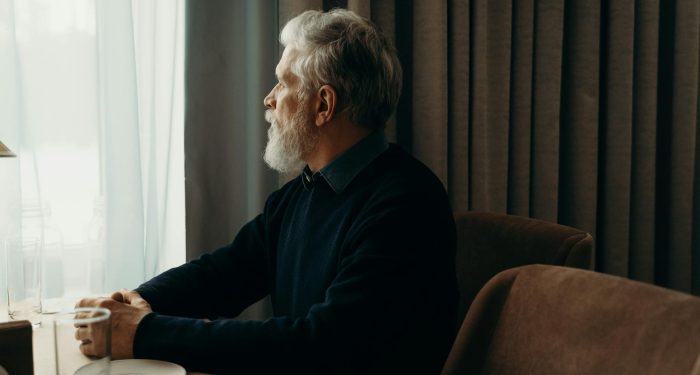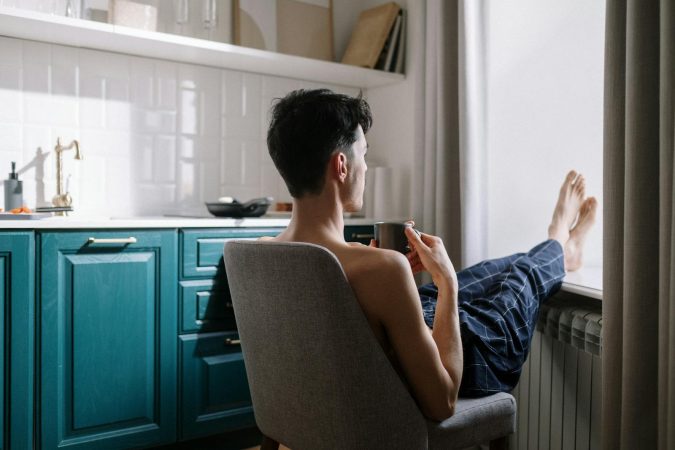
Most people confuse loneliness with solitude, mistaking tolerance for genuine enjoyment. The real difference lies in whether you've built something meaningful with yourself or simply accepted being alone.
There's a difference between enjoying your own company and tolerating it, and most people who claim the first are actually doing the second.
The conventional wisdom frames aloneness as a binary. Either you're a confident solo traveler who orders the tasting menu for one, or you're a lonely person who needs more friends. But the real split sits underneath that. It's between people who've built something with themselves and people who've just stopped expecting company to show up.
I've been thinking about this a lot lately. My partner James is an introvert who spends most of his working hours alone in his ceramics studio. I work from a home office that looks out over our garden. We have long stretches of parallel solitude that only work because we've each, separately, done the work of being okay in our own heads. That took years. It's not the same as just being used to the quiet.
And the good news is that "years" isn't the timeline for everyone. The distinction between enjoying your own company and merely tolerating it isn't a personality test you pass or fail at birth. It's a relationship you can develop. What follows are six markers that separate the two states, and each one doubles as a lever. If you recognize yourself in the "just adapted" column, you're not stuck there. You're just earlier in the process.
Here's what actually separates the two.
1. They don't fill the silence reflexively
Someone who's made peace with themselves can sit in a quiet kitchen without reaching for a podcast. Someone who's just adapted to being alone fills every moment with input. A show while cooking. A call while walking. A podcast in the shower.
Neither is wrong, exactly. But the reflexive filling is diagnostic. The writer of a recent essay on solitude versus loneliness describes the pattern precisely: evenings that opened up got immediately packed with something, anything, to give the silence a texture. The fear wasn't being alone. It was being alone with yourself.
The shift starts small. Cook dinner tonight with no audio. Not as a test of endurance, but as a low-stakes experiment. Notice what comes up. If the silence feels like a room you can move around in, you're further along than you think. If it presses, that's the edge worth sitting at. Briefly, repeatedly, until the pressing softens.
2. They choose solitude for a reason, not by default
Research on solitude has found that the why matters more than the aloneness itself. Solitude chosen for rest, reflection, or creative work produces measurably different outcomes than solitude that just happens because nothing else was available.
Psychologist Thuy-vy Nguyen, writing in The Conversation, notes that research has found a majority of Americans consider alone time essential for their mental health. That's not an epidemic of isolation. That's a population that knows what it needs and, increasingly, is willing to buy it.
People who genuinely enjoy their own company treat it like a practice. They protect it. They have a Saturday ritual, a morning hour, a drive they take alone on purpose. The ones who've just adapted to aloneness have stretches of empty time they haven't decided what to do with.
This is one of the most actionable differences on the list. If your alone time just happens to you, start choosing it. Block a single hour this week that's yours on purpose. Give it a loose intention: a walk, a meal you cook slowly, a sketchbook. The content matters less than the act of choosing. Aloneness you've selected feels different in the body than aloneness that showed up uninvited.
3. They have an internal voice that's at least civil
This one is the hardest to fake and the most important.
When you're at home with yourself, your internal monologue isn't necessarily warm, but it's not hostile. You can think about yourself without launching a tribunal. The mistakes you made last week come up occasionally, get examined briefly, and get put down.
When you've just gotten used to being alone, the internal voice is often sharper. Silence becomes an invitation for self-judgment. Rumination fills the space that used to be filled by other people's noise. Psychologists have framed this as the difference between finding your own mental space restful versus feeling stranded there.
I'll say the obvious thing. This isn't fixed. The people I know who've built real comfort with their own company almost all went through a period where they hadn't. The voice changed because they stopped letting it run unchallenged, not because they got lucky. When a harsh thought lands during quiet time, the practice is simple: notice it, ask whether you'd say it to someone you respect, and if the answer is no, let it pass without agreement. That's not affirmation culture. It's basic self-governance.
4. They're not using work or busyness as a hiding place
There's a version of solitude that's really just avoidance wearing a nice outfit. You're alone, yes. But you're also refreshing email, or deep in a project, or reorganizing the pantry for the third time this month. The aloneness is technical. The engagement with yourself is minimal.
This is one of those patterns that shows up later in life with real consequences. As I've written about before, the people who struggle most in retirement often aren't the ones who loved their careers most. They're the ones who used work as a structure to avoid meeting themselves. When the structure went, the person underneath it was a stranger.
People who enjoy their own company use work as work. When it's done, they can stop. The stopping isn't uncomfortable. It's the point.
5. They can be alone with something difficult
This is where the distinction gets practical.
A bad day lands. A rejection, a conflict, news that rearranges something. Someone who's at home with themselves can sit with the feeling for an hour before calling anyone. Not stoically, not permanently, but long enough to feel it without needing an immediate second party to metabolize it for them.
Someone who's just adapted to being alone often can't. The first instinct is to reach for company, any company, to regulate what's happening internally. That's not weakness. It's a nervous system that hasn't learned it can handle its own weather. But it's worth naming, because the connection you reach for in that state isn't additive. It's load-bearing. And load-bearing relationships, over time, get exhausted.
Research on solitude has found that connection you want is different from connection you need in order to be okay. The first makes good things better. The second makes unbearable things survivable. Only one is a foundation you can build on.
6. They don't confuse their solitude with self-sufficiency
One honest thing that deserves its own heading. There's a cost to being the person who's good alone, and the people who genuinely enjoy their own company know about it and manage it.
Research from Tilburg University, covered in Psychology Today, found that people who visibly prefer solitude tend to experience more ostracism from their social networks. Not dramatic exclusion. The quieter kind: being invited less often, being assumed unavailable, being treated as someone who probably wouldn't want to come anyway.
The people I know who've genuinely built a good relationship with themselves are also, usually, deliberate about maintaining the relationships around them. They text back. They host. They show up. Their solitude makes those interactions better, not rarer. The goal isn't to become so self-sufficient that you drift out of your own life. It's to make your company, your own and others', a choice rather than a crutch.

Where this actually leaves you
Every point above shares the same underlying mechanism: the shift from passive to active. People who enjoy their own company aren't doing anything exotic. They've just turned aloneness from something that happens to them into something they do on purpose, with attention.
Some of what moves people from the second category to the first is boring. Time spent without input. Small experiments with stillness. Letting an evening be unstructured and not panicking when it is. Learning that the internal voice can be argued with. Some of it is adjacent: building the kind of quieter daily satisfactions that make an afternoon alone feel like enough, rather than like a consolation prize.
But here's the harder question, and I'd rather leave you with it than with a tidy exercise. If the next unstructured evening arrived tonight, with nothing to watch, no one to text, nothing productive left to salvage from the day, who would actually be in the room? Not the version of yourself you perform at dinners. Not the one who writes the captions. The one who's there when no one's watching and no input is coming in.
Because that's the person you're going to spend the rest of your life with. And if you don't know them yet, the reason isn't usually a lack of time. It's that meeting them requires tolerating a stretch of silence most people will do almost anything to avoid. The podcast. The second pour. The phone. The project that could have waited.
So the decision isn't whether to do the ninety-minute experiment I was going to prescribe. It's whether you're willing to stop outsourcing the introduction. Nobody else can make it for you. And every year you don't, the stranger in the room gets a little harder to recognize.
If You Were a Healing Herb, Which Would You Be?
Each herb holds a unique kind of magic — soothing, awakening, grounding, or clarifying.
This 9-question quiz reveals the healing plant that mirrors your energy right now and what it says about your natural rhythm.
✨ Instant results. Deeply insightful.

Oliver Park
He/Him
Oliver Park writes about food with the precision of someone who spent a decade behind the line. A former professional chef turned food journalist, he covers plant-based cuisine, food science, and the culture of eating well. His recipes are tested, honest, and built to work on the first try. Based in Portland, Oregon.
More Articles by Oliver