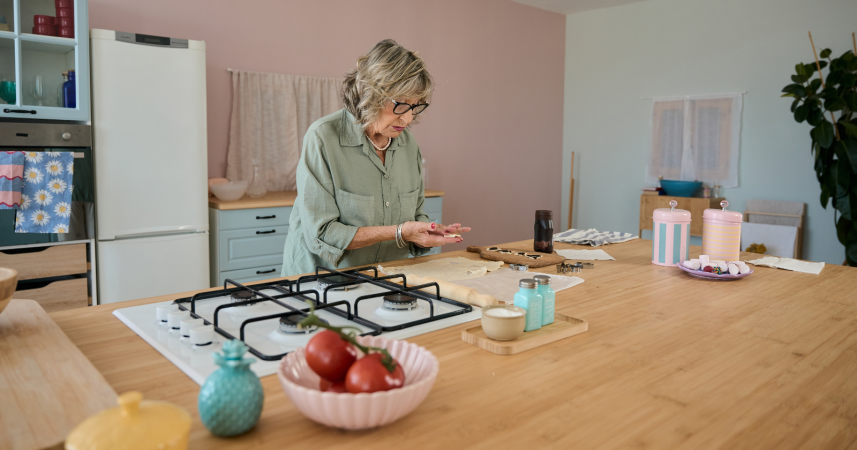
She scrubbed those counters with the fury of someone fighting an invisible war, and it took me twenty years and my own 2 AM breakdown with a bottle of bleach to realize she wasn't crazy — she was surviving.
I spent years resenting my mother's obsession with cleanliness. Every water ring on the coffee table was a crisis. Every crumb on the counter, a personal affront. I'd roll my eyes as she'd rewipe surfaces I'd just cleaned, her movements quick and anxious, like she was racing against some invisible deadline. It took me becoming an adult, facing my own helplessness in the face of life's chaos, to understand that she wasn't just cleaning. She was surviving the only way she knew how.
Two in the morning, a Wednesday, three weeks after my divorce papers were signed. I was on my hands and knees scrubbing bathroom grout with a toothbrush while my children slept down the hall. The bathroom was already clean. I knew it was clean because I'd cleaned it that afternoon. But I kept scrubbing, tears mixing with bleach fumes, knuckles raw against the tile, and somewhere between the second pass and the third I looked up and saw my mother. Not literally — she was forty miles away, asleep in her own immaculate house. But I saw her in my own hands, in the desperate rhythm of my movements, in the way I was grinding order into porcelain like it could save me from everything that had just fallen apart.
She had done this. For years. For decades. Every surface in our house polished until it reflected back a woman who refused to be undone. I'd watched it my entire childhood without understanding what I was watching. Now, at 2 AM with bleach under my fingernails and a divorce decree on the kitchen table, I understood perfectly.
When the world shrinks to four walls
My mother was twenty-eight when my father left. One Thursday afternoon, he packed his things while she stood in the doorway of their bedroom, holding my baby sister on her hip while I tugged at her skirt. By evening, she was alone with two toddlers, a mortgage she couldn't afford, and a teaching degree she hadn't finished. The world had become impossibly large and hostile, full of bills and judgments and responsibilities that threatened to swallow her whole.
So she shrunk it down to something manageable. Four walls. Six rooms. Surfaces that could be controlled, organized, perfected. While the bank sent notices and the car made troubling noises and the grocery budget dwindled to nothing, she could make those kitchen counters gleam like mirrors. She could create order in the linen closet. She could vacuum perfect lines into the carpet that proved, if only to herself, that she hadn't been defeated.
"Why does it matter if my bed has hospital corners?" I'd complain as a teenager, not understanding that those perfect corners were her daily victory cry. Each meticulously folded fitted sheet was evidence that chaos hadn't won, that she was still standing, still fighting, still capable of creating something precise and beautiful in a world that felt like it was falling apart.
The inheritance of spotless surfaces
Virginia Woolf wrote about needing a room of one's own. My mother needed a clean one. But this need, I discovered, was inherited like eye color or stubborn hair. Looking through old photos after my grandmother's funeral, I found picture after picture of immaculate homes. Depression-era kitchens with surfaces so clean they seemed to glow. My grandmother, who'd raised six children on a mailman's salary, standing proudly beside her perfectly organized canning shelves.
My aunt told me stories I'd never heard. How my grandmother would wake at 4 AM to scrub floors before her shift. How during the worst years, when they were eating beans for the fifth night in a row, the house never showed their poverty. The windows sparkled. The floors shined. Dignity, my aunt explained, was sometimes the only currency they had, and my grandmother spent it lavishly on cleanliness.
This was our inheritance: the knowledge that when you can't control whether there's food in the pantry, you can control whether that pantry is organized. When you can't fix your husband's drinking or your child's learning disability or your mother's cancer, you can fix the chaos in your junk drawer. You can create small pockets of perfection in an imperfect world.
The expanding battlefield
As my mother grew older and life stabilized, I expected the compulsive cleaning to fade. She'd remarried a kind man who helped with the dishes. She'd finished her degree and taught high school English for thirty-two years. Both her children had graduated college, married, given her grandchildren. Surely now she could relax her vigilance.
Instead, the territory simply expanded. Now it wasn't just the house but the garden, where every weed was vanquished with military precision. The classroom, where her desk remained pristine even as teenagers chaos swirled around her. The widow's support group she'd eventually joined, organizing their grief into manageable meetings with clear agendas and always, always, a clean meeting space.
Have you ever noticed how many women's stories involve cleaning? We joke about stress cleaning, revenge cleaning, grief cleaning. But there's something profound in these acts of creating order. When my mother's second husband was diagnosed with Parkinson's, she couldn't stop the tremors or slow the progression. But she could make sure every pill was organized by day and time, every appointment recorded in her perfect handwriting, every medical record filed with precision that impressed even his doctors.
Understanding the armor
The day I truly understood my mother's relationship with cleanliness was the day my teenage daughter was diagnosed with postpartum depression. That afternoon, while she slept off the emotional exhaustion of too many tests and too many questions, I found myself reorganizing every bookshelf in our house. Fiction alphabetized by author. Non-fiction sorted by subject. Children's books arranged by height.
My hands moved with the same desperate efficiency I'd witnessed in my mother thousands of times. Each perfectly aligned spine was a small prayer: *If I can create order here, maybe I can create order there. If I can control this space, maybe I can control what happens to my child.* It was magical thinking, but it was also survival. It was something to do with the terror that threatened to paralyze me.
Later, my mother came over with soup and fresh bread. She surveyed my reorganized living room, my gleaming kitchen, my spotless bathrooms. She didn't comment on the cleaning. Instead, she pulled me into a hug and whispered, "You're going to be okay. She's going to be okay. And if you need to reorganize my house next, you're welcome to it."
The gift of gleaming surfaces
Now I see my mother's spotless house differently. Those gleaming counters weren't just clean surfaces; they were daily proof of her strength. Every organized closet was a small rebellion against chaos. Every vacuumed carpet was a declaration: *I'm still here. I'm still fighting. I haven't given up.*
She gave me many gifts growing up, but perhaps the most valuable was this: the knowledge that when life feels completely out of control, you can always clean something. You can always create one small space of order. You can always fight back against entropy, even if it's just in your own kitchen.
These days, my mother still keeps an immaculate house, but the desperate edge has softened. At seventy, she cleans now like she's tending something beloved rather than defending something besieged. Her kitchen counter still gleams, but it's also covered with evidence of a life being fully lived: flour from baking with grandchildren, soil from repotting plants, cards from her hiking group, drafts of letters she writes for Amnesty International.
Final thoughts
My mother kept a spotless house every single day of my childhood like her dignity depended on it because, in many ways, it did. In those acts of cleaning, she found power when she felt powerless, control when life spun wildly beyond her grip, and proof that she could create beauty and order even in the midst of chaos. Her gleaming counters were never about the counters. They were about survival, dignity, and the fierce insistence that she would not be defeated.
I know all of this now. I can name it, trace its origins, see the inheritance clearly. And yet last Tuesday, when the doctor called with test results I wasn't expecting, I hung up the phone and spent two hours cleaning out the refrigerator. Every shelf removed, every surface wiped, every expired container discarded. When I finished, I stood back and looked at the perfect rows of condiments, the gleaming glass shelves, the crisp organization of it all. I thought of my mother. I thought of my grandmother. I wondered if understanding a pattern is the same thing as being free of it, or if knowing why you're on your knees scrubbing just means you're on your knees scrubbing with better vocabulary.
The refrigerator looked beautiful, though. It really did.
What’s Your Plant-Powered Archetype?
Ever wonder what your everyday habits say about your deeper purpose—and how they ripple out to impact the planet?
This 90-second quiz reveals the plant-powered role you’re here to play, and the tiny shift that makes it even more powerful.
12 fun questions. Instant results. Surprisingly accurate.