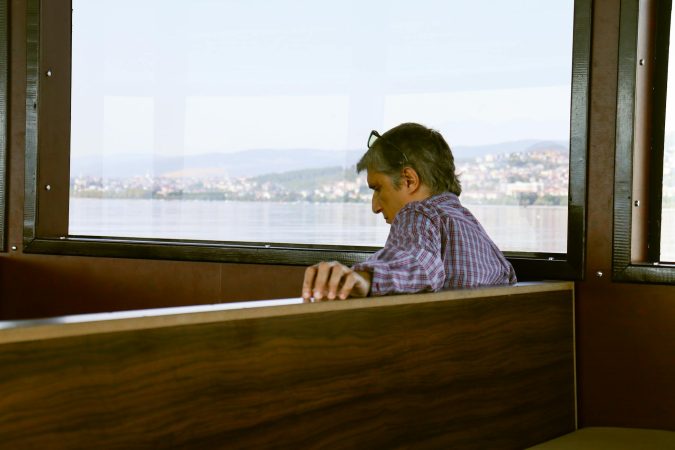
The quiet tragedy of the over-prepared mind is that it spends decades rehearsing answers for a conversation that never arrives.
My uncle used to rehearse arguments in the car. I'd catch him at it when I was a kid riding shotgun, his lips moving at red lights, his hand occasionally lifting off the wheel to punctuate a point nobody was making. He was preparing, I eventually understood, for conversations he was pretty sure were coming. A brother who might finally ask why he left the family business. A wife who might want to know what he actually thought about her mother. He had answers ready for all of it, delivered in the privacy of a Buick.
He died without having most of those conversations. The answers went with him. I've thought about that a lot, because he wasn't unusual. Researchers who study rumination describe something that looks mechanically similar: loops of planning and rehearsing running on quiet rotation in the background of ordinary life. They frame it as a mental health concern, which it often is. But some of what gets caught in that net isn't anxiety exactly, and isn't depression. It's the thoughtful person's specific affliction. The habit of constructing careful, considered, nuanced answers to questions the world never actually asks.
Most people assume the great regret of a reflective life is not having said enough. The regret of the inarticulate, the unspoken, the swallowed reply. That's one kind of grief, and it's real. But it isn't the grief I'm describing. The grief I'm describing belongs to people who were more than ready. People who read the book, researched the subject, thought through the position, anticipated the objections, drafted the response in their head while walking the dog. People who prepared a life's worth of considered answers and then slowly realized, somewhere in their forties or fifties or later, that nobody was ever going to ask.
The questions that never came
There's a particular cast of mind that treats life as an oral exam. You spend years watching your family, your colleagues, your friends, and you develop theories. About why your brother drinks. About what your mother actually wanted. About the strange gravity of your own ambition. You refine these theories. You stress-test them against new information. You hold them ready, because surely, at some point, someone close to you will want to know. Surely someone will sit across from you and ask the question that unlocks everything you've been assembling.
They don't. Or if they do, it's a version of the question so narrow, so distracted, so half-listening, that the answer you've prepared cannot fit through the opening. You offer a fragment. They nod. The conversation moves on. You go home and the rest of the answer stays where it's always been, somewhere behind your sternum, carefully catalogued and shelved.
This happens enough times that you stop noticing it's happening. The preparation continues. The asking never catches up.
A library nobody visits
Carl Jung spent much of his later work on what he called the unlived life. The aspects of a personality that never got to develop, the possibilities that died quietly inside a person who was otherwise functional and even successful. The concept has been called haunting precisely because it names something most people sense but cannot quite articulate: that you can be fed, employed, loved, and still be carrying an enormous unmet portion of yourself.
Jung mostly meant paths not taken. The musician who became an accountant. The woman who never left her hometown. But there's a version of the unlived life that's subtler and, in some ways, sadder, because the person did take the path. They became the thinker, the reader, the observer, the one who pays attention. And then they discovered that the social infrastructure for what they'd become doesn't really exist. The depth accumulated. The audience for it didn't.
So you end up with a private library nobody visits. Volumes of thought on your marriage, your father, your work, your country, your species, and the people closest to you mostly want to know if you picked up milk.
The shape of this particular grief
It doesn't present as grief. That's part of what makes it so hard to name. It presents as a mild, chronic disappointment after social events. A flatness on the drive home from dinner. A recurring sense of having been almost-met, not quite reached. You came ready to be known and you were greeted warmly and the evening was, by every external measure, fine. But something you brought wasn't opened.
Over time this accumulates into something with weight. The repetitive cognition researchers describe in depression looks, from the outside, like the same machinery that powers a rich inner life. The thoughtful person has been training this machine since childhood. It runs all day. It runs when nothing is asked of it. It's still running while you brush your teeth, still running while you wait for the kettle, still drafting replies to conversations that ended in 2004.
This is related to, but not the same as, the rumination pathologies. Some people avoid the inner conversation entirely. The people I'm describing have the opposite problem. They've had the inner conversation so many times they've memorized both sides. They're waiting for someone else to take a seat at the table.
Why thoughtful people keep preparing anyway
You'd think, after enough unasked questions, a person would stop preparing. They don't. That's the strange mechanics of it. The preparation isn't really about the other person. It's a way of organizing an interior that would otherwise feel unbearable. The answers are a scaffolding. They keep the self from collapsing into the mere series of its errands.
Which means the grief isn't just about the missed connection. It's also about the slow recognition that the scaffolding was always, partly, for an imagined audience. Some version of the self that was constructed to be understood by someone who would eventually take the time. A parent who might one day ask what you actually thought about any of it. A partner who might become curious about the parts of you that didn't serve them directly. A child, later, who might turn around and want to know who you were before them.
I want to be careful here, because there's a temptation to call this noble. It isn't, particularly. The thoughtful person, who is usually also the one who learned early not to impose, will almost never volunteer the answer unprompted. That restraint gets dressed up as tact, but a lot of it is just fear. Fear of taking up space, fear of being found tedious, fear of the specific humiliation of offering something interior to someone who didn't want it. So the answer stays inside. And inside, it ages.

The moment of recognition
It often arrives late. A woman I'll call Mara told me about driving home from her mother's funeral and realizing, somewhere on the expressway, that her mother had never once asked her what she actually thought about anything substantive. Not her marriage. Not her work. Not her miscarriage. Not her decision to leave the church. Thirty years of considered answers, rehearsed at various ages, updated as Mara got wiser. Her mother had loved her. Her mother had also, in Mara's words, treated her daughter's mind like weather. Something you acknowledge politely and then move past.
What Mara was grieving on that drive wasn't only her mother. It was the entire project of preparation. A whole archive of replies now permanently unaddressed. There was no one left to ask. There may never have been anyone planning to.
I sat with this grief for a long time before I realized it was connected to something broader, the hidden cost of being highly intelligent, which I ended up exploring in a video that unpacked all the ways preparation without audience becomes its own peculiar ache.
This is the recognition the piece began with. It arrives in different ways. Sometimes on a drive home, sometimes at a retirement party, sometimes when a long friendship ends and you realize the friend took an account of you that never included the things you'd most wanted seen. It has a specific texture. It feels like nostalgia with no home to return to, because the home was theoretical. It was the possible conversation, not the actual one.
What to do with an unasked life
I'm wary of the part of the essay where the writer offers a tidy reframe. There isn't one. The grief is real and the losses are real and the questions that didn't come aren't going to retroactively arrive. Some of the people who might have asked are dead. Some are alive and still not asking. Some never had the capacity, and blaming them for it has its own exhaustion.
What I've watched thoughtful people do, the ones who seem to carry this best, is something quieter than reframing. They stop waiting to be asked. Not bitterly. Not with a sudden need to unload. More like they finally give themselves permission to be the first one at the table. They start writing things down that no one requested. They say the thing at dinner even though the opening was narrow. They take up a fraction more space, and discover that the guilt of that taking-up eventually thins, though it doesn't disappear.
They also, and this matters more than it sounds, start asking other people the questions they themselves were never asked. Not as strategy. As recognition. Once you know what it's like to carry decades of unrequested answers, you become alert to the same shape in other people. You ask the question you wish someone had asked you. You listen long enough for the real reply, not the fragment. You become, late in life, the audience you once needed.
The last, quietest part
A friend once said to me that he'd realized, in his sixties, that the deepest things he knew were things no one had ever asked him to articulate. He'd articulated them anyway, to himself, over decades. He didn't sound bitter about it. He sounded slightly amused, the way you are about a long, private joke.
Then he said something I've been chewing on ever since. He said that if he had any advice, it was to stop measuring your interior by whether it ever got requested. I understood what he meant. I don't think I believe it, exactly. The preparation shaped him, sure, but it also ran in circles for sixty years looking for a listener, and calling that a life well-lived feels like the kind of thing you say when the alternative is unbearable.
Maybe that's what most of us settle into. Not peace with the unasked life, but a working arrangement with it. You keep preparing. You know, now, that a lot of it will never be collected. You carry the answers around anyway, because you don't know how to stop, and because there's still the off chance that someone, somewhere, will turn to you and ask. The grief doesn't lift. It just learns to sit quietly, next to everything else you've prepared and nobody has asked for.
If You Were a Healing Herb, Which Would You Be?
Each herb holds a unique kind of magic — soothing, awakening, grounding, or clarifying.
This 9-question quiz reveals the healing plant that mirrors your energy right now and what it says about your natural rhythm.
✨ Instant results. Deeply insightful.

Justin Brown
Justin Brown is a writer and media entrepreneur based in Singapore. He co-founded a digital media company that operates publications across psychology, sustainability, technology, and culture, reaching tens of millions of readers monthly. His background spans digital strategy, content development, and the intersection of behavioral science and everyday life.
At VegOut, Justin writes about plant-based living, food psychology, and the personal dimensions of changing how you eat. He is interested in the gap between knowing something is good for you and actually doing it, and his writing explores the behavioral and emotional forces that make lasting dietary change so difficult for most people.
Outside of publishing, Justin is an avid reader of psychology, philosophy, and business strategy. He believes that the best writing about food and lifestyle should challenge assumptions rather than confirm them, and that understanding why we resist change is more useful than being told to change.
More Articles by Justin