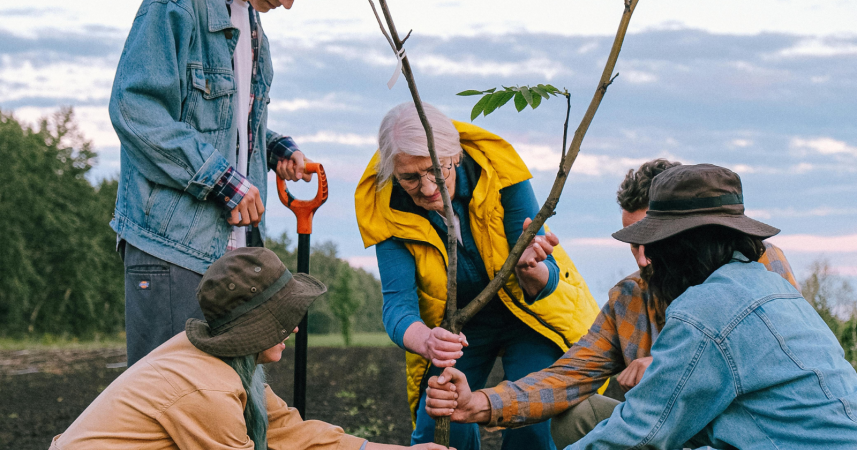
At 70, with dirt under my fingernails and knees that haven't forgiven me, I discovered that planting trees for strangers' shade feels more meaningful than any lesson I taught in 32 years of classrooms.
The shovel slipped in my hand for the third time that morning, and I sat down harder than I meant to on the damp November ground. Sapling number forty-three — a serviceberry, if I remember right — was still leaning at the wrong angle in the hole I'd spent twenty minutes digging. My knees, both replaced five years apart, were already done with me. The surgeon's voice floated back: *nothing strenuous, nothing repetitive.* I laughed out loud in the empty field. What would you call this, then?
I pressed the root ball in anyway, packed the soil with the heel of my palm, and let the little tree stand on its own. Forty-three down. Twenty-seven to go. One tree for every year I've lived, and I was going to finish them if it took the rest of the autumn and most of what was left of my hands.
The idea had come to me a month earlier during one of those restless nights. I'd been lying there thinking about the elementary school near my walking route, how it was being torn down for condos. Just erased, as if all those children who'd learned to read there, all those teachers who'd shaped young minds, had never existed. The thought kept circling: What remains? What lasts? By morning, I knew what I needed to do.
You'd think after thirty-two years of teaching high school English, I'd have had enough of planting seeds that take years to bloom. All those teenagers I tried to convince that Steinbeck mattered, that their own stories were worth telling. Most days I never knew if any of it took root. A decade might pass before a former student would write to say they'd become a teacher, or a parent, or simply someone who still loved books. The waiting, the not knowing, used to drive me crazy.
But something shifts when you reach 70, or at least it did for me. Maybe it's watching your body betray you in small ways daily, needing reading glasses to see the medicine bottles, stretching for ten minutes each morning just to walk without limping. Or maybe it's having buried friends and family and understanding finally that we're all just temporary. Whatever the reason, I found myself at the nursery, loading saplings into my car like a woman possessed, the teenage employee looking concerned as I kept adding more. "Big project?" he asked. I just smiled.
Each tree became a meditation. The willow by the creek for my mother. The maple for my mentor teacher who saw something in the struggling single mother I was and insisted I belonged in the classroom. A dogwood for a student, whose essay about feeling invisible still sits in my desk drawer. A pine for the stranger who paid for my groceries when my card was declined and my children were watching. These stories, these people, they deserved something that would outlast my memory of them.
My neighbor's teenage son helped with the heavier work. He didn't ask why I was planting so many trees, just showed up each morning that week with his shovel. His mother had been my student once, years ago, one of those kids who sat in the back row. Now she's a social worker, and her son was helping her old English teacher plant trees. The circles we make without meaning to.
By the fourth day, my body was screaming. But I kept going.
I thought about my own childhood, the oak in our backyard where my father, a mailman who knew everyone's business but kept it to himself, taught me that community meant showing up even when you didn't feel like it. That tree is probably still standing in Pennsylvania where strangers now live. They don't know that a little girl once built fairy houses in its roots, or that a tired man used to sit beneath it after walking miles. But the shade remains, the shelter continues, indifferent to who planted it or why.
On the last day of planting, I stood among my trees as the sun set. They looked so small, so vulnerable. A bad storm could take them. Disease, drought, any number of things could prevent them from becoming what I imagine. But that's always been true, hasn't it? We plant in faith, not certainty.
I think about the literature I taught all those years, how the best stories trust readers to find their own meaning. How Fitzgerald never knew that Gatsby would be taught in every high school in America. How Emily Dickinson died with her poems tucked in a drawer, never knowing they'd survive her. We cast our seeds and turn away, having to trust that somewhere, somewhen, something will grow.
Last week, walking among my 70 trees in the evening light, my hip aching enough that I had to stop twice, I touched each small trunk. Some no thicker than my thumb, but already reaching toward sky. A family of cardinals has claimed the pine closest to the house. The deer have discovered the young oaks.
I don't know which of these trees will make it. I don't know who, if anyone, will stand beneath them in forty years and wonder who put them here. I planted them anyway. Maybe that's the whole thing, or maybe it isn't — I keep turning it over and I can't quite tell. The cardinals don't seem to be waiting for me to figure it out.