New Mexico is breaking ground on a 155,000-square-foot greenhouse to triple seedling production and tackle a 385-million-tree backlog left by two decades of wildfire.
New Mexico is trying to outpace its own wildfires — and rethink what reforestation means in a warming Southwest. The state is breaking ground on a greenhouse complex designed to triple seedling production and replace imported trees with stock bred for the climate the region is heading toward, not the one it's leaving behind. The bet is that survival, not sheer planting volume, is what reforestation in a drying landscape actually requires.
Wildfires have burned millions of acres across New Mexico since 2000, and the state's existing burn scars need hundreds of millions of trees to recover. The Hermit's Peak-Calf Canyon Fire alone, one of the largest in state history, requires millions of seedlings. At current production rates, replanting that single burn scar would take decades.
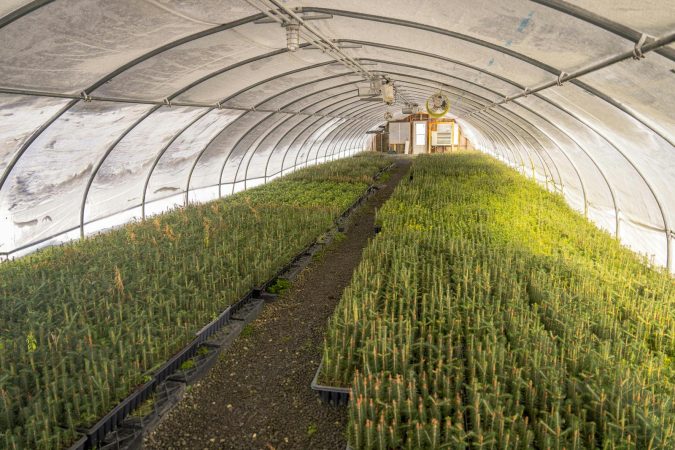
That gap is what the New Mexico Reforestation Center, a collaboration between the state Forestry Division, University of New Mexico, New Mexico State University, and New Mexico Highlands University, is trying to close. Director Jennifer Auchter noted that current operations grow roughly 250,000 to 300,000 seedlings annually at the aging John T. Harrington Forestry Research Center. Most additional trees are purchased from growers in Idaho, where the climate and elevation don't match New Mexico's planting sites — leaving seedlings to struggle from the moment they go in the ground.
The new center is taking a different approach. Researchers at UNM are modeling seedling survival against the projected 2100 climate, not today's. New Mexico State University is drought-conditioning ponderosa pines and other species so they're acclimated to dry conditions before planting. For aspens, researchers are testing whether placing seedlings beside logs for partial shade improves early survival. The seed-processing facility uses a repurposed chili roaster to extract seeds from cones and pods.
Auchter framed the stakes in terms of water rather than timber, pointing out that the majority of New Mexico's supply comes from snowpack and precipitation captured by streams in forested areas. After a high-severity burn, she noted, natural forest regeneration may take centuries — far beyond a human lifetime. The downstream consequences are already visible: floods through the Hermit's Peak-Calf Canyon scar have been contaminating drinking water in communities below the burn.
The conventional climate-solutions story tends to lean on tree-planting as a feel-good metric, with little attention to whether the trees survive. New Mexico's project pushes back on that framing. The bottleneck isn't public enthusiasm or even funding for greenhouses; it's seed collection, regional genetics, and survival science — the unglamorous middle of the pipeline that Auchter says is tedious, time-consuming, and labor-intensive, and where the New Mexico Highlands University team does much of its work.
That's the quiet shift worth watching. Reforestation in the Southwest can't be modeled on the wetter Pacific Northwest, where past efforts have leaned on dense plantings of genetically uniform stock that fail in arid soils and reburn at higher severity. If the NMRC succeeds, it could become the regional hub Auchter envisions for the Four Corners states — pairing locally adapted seed sources, drought-hardened seedlings, and climate-forward site selection into a template for how dry-climate recovery actually works when forests are treated as water infrastructure rather than scenery.