She discovered that gray hair wasn't just changing her appearance — it was quietly revoking permissions she didn't know she'd been granted, from finishing sentences to having her doctor take symptoms seriously.
I was three sentences into explaining the library's new acquisitions budget when the woman across the table — thirty years my junior, four months on the board — reached over my voice like it was a shared condiment and said, "What Margaret is trying to say is..." I hadn't been trying to say anything. I had been saying it. I stopped mid-word, waited for her to finish summarizing my position incorrectly, and watched the table nod along to her version.
That was month four of growing out my gray.
I went home, sat in my car in the driveway for a while, and tried to remember the last time someone had done that to me when my hair was still honey blonde. I couldn't. Not because it had never happened, but because it had happened so rarely I hadn't built a category for it. Now I needed a category. Now I needed to understand what I'd stopped buying when I cancelled my standing appointment with my colorist last year, because whatever it was, the world had noticed its absence before I had.
The expensive illusion I'd been maintaining
For decades, I inhabited that salon chair like it was my second home. Every six weeks, watching my stylist transform my telltale roots into something more socially acceptable while we chatted about grandchildren and grocery prices. The ritual felt as essential as morning coffee, as automatic as breathing. Eighty-five dollars plus tip, that lingering chemical smell that followed me for days, the constant calendar math calculating when the gray would start showing again.
I never questioned it, the same way fish don't question water. It was simply what women did, what we'd always done, part of the invisible maintenance of remaining visible.
My hair had always been my signature, carefully curated through the decades. Chestnut brown in my twenties, auburn through my thirties and forties when I thought it made me look sophisticated, then honey blonde to "soften" the years, as the stylist diplomatically put it. Each shade a small negotiation with time, a plea bargain with aging.
When the shift began
Something cracked open after my seventieth birthday. Maybe it was watching my granddaughter deliberately dye her gorgeous hair silver, paying good money for what I was paying to hide. Or finding my mother's photograph from the early sixties, her natural gray swept into that era's beehive, looking absolutely regal. Perhaps it was simple exhaustion from the pretense.
"Just let it grow," I told my stylist, and she looked at me like I'd suggested walking naked through town.
The transition was brutal. Those first three months, I lived in scarves and avoided reflective surfaces. The gray emerged striped and strange, a badger-like demarcation between my constructed self and whoever was underneath. My daughter gently offered "touch-up" suggestions, my son stayed diplomatically silent, and friends shared their colorists' numbers like passing along miracle cures.
But I persisted, driven by equal parts stubbornness and curiosity. After surviving single motherhood, working multiple jobs, two knee replacements, and widowhood, surely I could handle some gray hair?
The world recalibrates with stunning efficiency
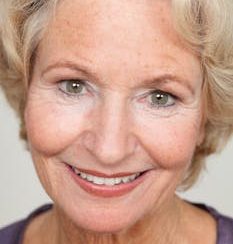
The physical reality proved easier than expected. My gray isn't uniform silver but salt and pepper with streaks of pure white, like winter grass touched by frost. It required new makeup, cooler tones, different lipstick. My watercolor teacher said it caught the light beautifully, "like moonlight," and I chose to believe her.
But here's what nobody mentions: the social recalibration happens with algorithmic precision.
Have you ever noticed how quickly people adjust their assumptions? The twenty-something barista who usually chatted became professionally distant overnight. The hardware store clerk started explaining things I hadn't asked about, speaking slowly as if I might not grasp the difference between Phillips and flathead screwdrivers. At library board meetings I've attended for six years, younger members began repeating my points as if translating for someone not quite following along. During my granddaughter's college tour, the guide directed all questions to her father, though I'd researched the financial aid packages and helped with essays. The same doctor I've seen for fifteen years suddenly had nurses asking if I'd brought someone with me, if I needed help understanding prescriptions. Teaching teenagers for thirty-two years had taught me to be concise, yet suddenly I couldn't complete a sentence without someone jumping in, usually incorrectly. Book club discussions I'd led for years became exercises in being talked over. During volunteer training at the women's shelter, where I've taught resume writing for a decade, the new coordinator kept cutting me off to "modernize" perfectly current advice. I started timing conversations, and what used to meander for ten minutes wrapped up in three.
None of this was imagined. None of it was a coincidence.
Even at the senior center's Italian classes, the instructor assumed I'd need extra time, though languages have always come easily to me.
Understanding what the dye was actually buying
Virginia Woolf wrote about needing money and a room of one's own. She didn't mention needing hair dye to keep your voice from being erased mid-sentence.
The invisibility was almost worse than condescension. At social gatherings, conversations flowed around me like water around a rock. Waiters asked my dining companions what I'd like to order. At my son's office party, colleagues expressed genuine surprise that I had opinions about current events, knew about podcasts, understood cultural references. "You're so with it!" one exclaimed, as if basic awareness deserved a medal.
I understood then what those salon visits had been purchasing: the benefit of the doubt. The assumption of competence. The courtesy of complete sentences. For $85 every six weeks, I'd been renting relevance in a society that measures women's worth by their distance from visible aging. That isn't a neutral exchange, and I no longer pretend it is. The dye was a tax, and I paid it for forty years without calling it what it was.
One particularly brutal week, I actually made an appointment with my stylist. After being ignored at a community meeting where I'd volunteered for twenty years, after security followed me through Target, after my physician dismissed fatigue as "just your age" without a single test, I sat in my car outside the salon, engine running, watching women emerge with their armor freshly applied.
Choosing visibility on my own terms
But I couldn't do it. Not from pride or principle, though those played a part. I couldn't because my eight-year-old granddaughter had started calling my hair beautiful, running her fingers through it during story time. Because my widow's support group had become my fiercest advocates. Because I'd started writing essays and couldn't write authentically while hiding behind chemicals.
So I adapted, in the small ways available. I speak louder now. When interrupted, I say, "I wasn't finished," and continue, though I notice I have to say it more often than I used to, and some days the correction itself costs more than the interruption.
I've also found my people. The watercolor class where only color matters. The hiking group where our gray heads bob up mountain trails like dandelions. The library where the young librarian asks for recommendations and actually reads them. The women's shelter where my students care only that I show up and help craft resumes that might change their lives.
Sometimes I catch my reflection and see my grandmother. Sometimes afternoon light makes my hair gleam like spun silk against my turquoise scarf. Sometimes my daughter mentions how much I look like Mom now, and we both tear up, missing her but finding her in my mirror.
Final thoughts
The woman at the board meeting still summarizes me. The barista is still distant. The doctor still shorthands my symptoms into my age. I have found rooms where this doesn't happen, and I have learned which rooms those are, but I have not found a way to make the other rooms stop, and I'm not sure there is one.
What I know is that I'm not going back to the dye. What I don't know is whether that's a victory or just a different kind of bill, paid in a different currency, for the rest of whatever time I have. Some mornings it feels like the first. Some mornings it feels like the second. Most mornings I brush my silver hair and leave the house anyway, and that has to be enough, because it's what there is.