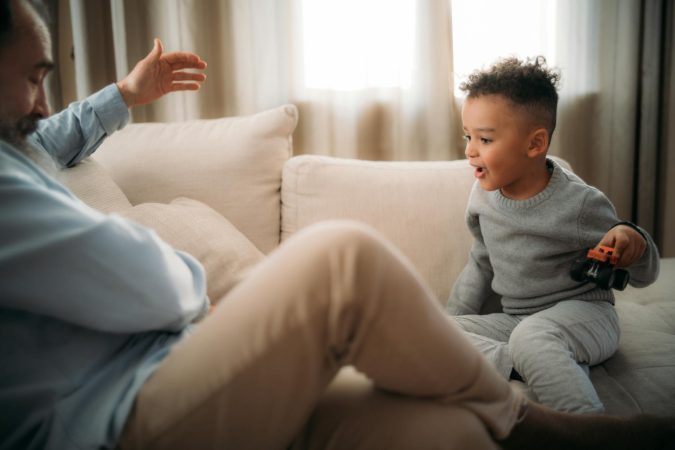
At seventy, I'm watching my generation fumble through emotional vocabulary our grandchildren learned in preschool — and the gap between us isn't generational, it's architectural.
My granddaughter, who is eight and obsessed with mysteries, told me last week that she had been feeling "overstimulated" at school. She used the word correctly. She used it the way I might have once said "tired," except tired was the only word any of us had, and we used it to mean everything from grief to hunger to the particular exhaustion of being a child in a house where the adults were performing fine.
I sat with that for a while after she went home. Overstimulated. At eight.
Most people my age would tell you this is what's wrong with kids today — that they have too many words for things that used to just be life. That we managed without a vocabulary for our inner weather and turned out, what, exactly? Functional. Employed. Married, sometimes more than once. Capable of getting through a Sunday dinner without naming a single feeling at the table.
But I've come to think the problem runs the other direction. My generation wasn't given fewer feelings. We were given fewer permissions. And now, in our seventies, we're being asked to suddenly become emotionally fluent for a generation of grandchildren who can name, at five, what we couldn't name at fifty.
The Architecture of the 1950s Living Room
I grew up between São Paulo and Miami, which means I grew up watching two cultures execute the same emotional contract in slightly different accents. The contract was this: feelings stayed inside the house. Inside the house, feelings stayed inside the body. Inside the body, they preferably stayed inside a place you didn't look at directly.
My father drove like he was angry at the road. My mother kept the kitchen clean the way some people pray. Nobody said the word anxiety in our house, ever, though it lived with us like a quiet third parent. When my grandmother in São Paulo — she's eighty-seven now and still lives there — lost her own mother, she went back to work the next morning. Not because she had to. Because that was the available response. Grief was something you carried while continuing to set the table.
This wasn't cruelty. This was the parenting style of an entire generation, shaped by depression, war, immigration, and the broad cultural conviction that emotional containment was the same thing as character. To have feelings was human. To discuss them was indulgent. To act on them was, in some homes, dangerous.
My generation absorbed this completely. We didn't reject it — we couldn't have, we had no other model. We grew up. We had children. And then, somewhere between our children and our grandchildren, the rules changed without telling us.
What the Grandchildren Were Given That We Weren't
My granddaughter has a poster in her bedroom with cartoon faces representing different emotions. Frustrated. Disappointed. Embarrassed. Lonely. Proud. There are about thirty of them. She points at one when she can't find the words, and her parents have trained themselves to ask, gently, what color the feeling is, where she feels it in her body, whether it needs something or just needs to be noticed.
I watched this happen at a recent visit and felt something I couldn't immediately name — which, of course, was the entire point.
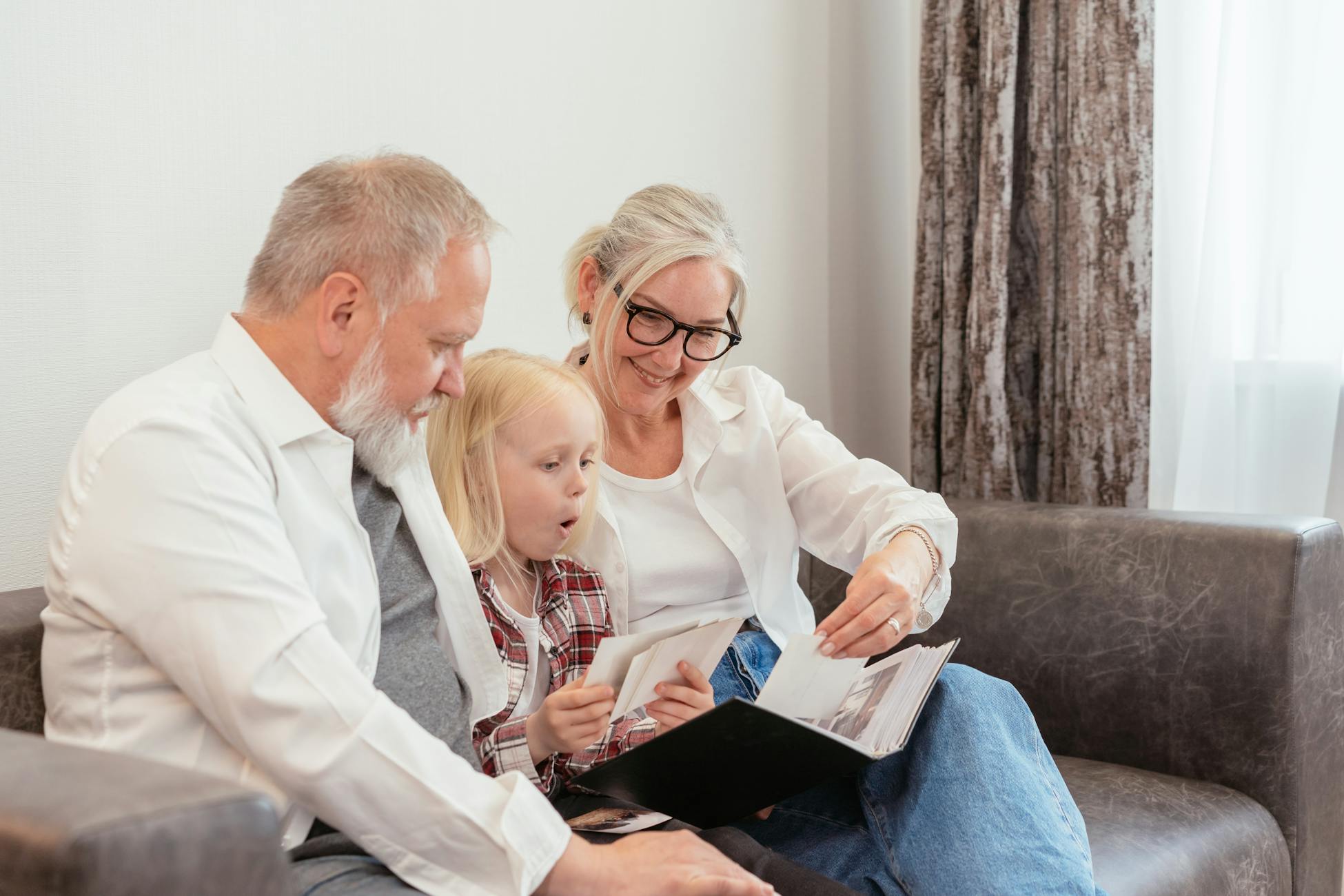
Children today are raised inside a much more deliberate emotional vocabulary than I ever had access to. They are taught that frustration is different from anger, that disappointment is different from sadness, that overwhelm has a specific shape and a specific exit. My granddaughter, at eight, has more words for her interior life than I had at forty. Possibly fifty.
And here is what nobody warned me about: the grandchildren are not just learning these words for themselves. They are bringing them home to us. They are asking us, the people who built our entire personalities around the principle that emotions are managed by not naming them, to suddenly speak fluent feeling.
The Late-Life Demand
I went to a widow's support group for the first time about eighteen months after my husband died. I had refused to go for a long time. The group leader asked us, in our second meeting, to describe where we felt grief in our bodies.
I sat there. Sixty-eight years old at the time, university-educated, two careers behind me, a book published, fluent in three languages, and I genuinely did not know how to answer the question. Not because I wasn't grieving — I was so submerged in grief I could barely walk through my own apartment without forgetting why I'd entered a room. I didn't know how to answer because nobody had ever asked me that before, and I had spent my entire life ensuring that nobody would.
Another woman in the group struggled to articulate where she felt her emotions physically, eventually gesturing to her chest and throat as she worked to put feelings into words. And I thought: she's doing it. She's translating. She's pulling words out of a place that was, for both of us, sealed shut for sixty years.
This is what's being asked of us now. Not just by therapists and support groups — by our own grandchildren. They want us to be present in a way our parents never were with us. They want us to say, when they're sad, that we see they're sad. They want us to ask follow-up questions. They want, in some quiet way, for us to model an emotional vocabulary we were never given.
What the Brain Will and Won't Do at Seventy
Here is the part that surprised me most. The assumption I'd been carrying — that this kind of fluency was a young person's project, that I'd missed the window, that my brain was set in its grooves and I should accept it — turns out to be wrong.
Older brains can still build new networks for learning, and a single significant experience can rewire a circuit — which, if you've ever had a grandchild ask you a question you couldn't answer, you already suspected.
The brain at seventy is not the brain at seven. It will not absorb a new emotional vocabulary the way my granddaughter is absorbing hers. But it can, with effort, learn to recognize what's happening inside it. It can learn, slowly, to find the word for the feeling instead of swallowing the feeling and reaching for a task.

The Translation Work
I started journaling at thirty-six, for reasons I won't go into here, and I have forty-seven notebooks now. For the first twenty years, those notebooks were almost entirely descriptions of what happened. Where I went. Who said what. The weather. It took me until my fifties to start writing about how anything felt, and even then I had to borrow words. I used to copy phrases from novels because I didn't trust my own.
What I've noticed, since the widow's group, since my granddaughter started narrating her interior life at the dinner table, is that the words come more easily now. Not because I've gotten younger. Because I've been given permission, late, to use them. The grandchildren are doing for us what nobody did for our parents — they're holding open a door we were taught to walk past.
The research on grandparent-grandchild dynamics tends to focus on what we transmit to them — values, history, recipes, languages. What gets discussed less is what they transmit to us. And in this particular generational handoff, what they're transmitting is a vocabulary their great-grandparents would have considered indecent to use out loud.
What Fluency Actually Looks Like at Seventy
I'm not going to pretend I've become fluent. I haven't. I still default, in moments of stress, to the emotional vocabulary of my mother's kitchen — which is to say, I clean something. I make tea. I take the subway somewhere I don't need to be. The body remembers the old contract long after the mind has signed a new one.
But last month my granddaughter asked me, while we were walking back from the library, whether I missed her grandfather. And instead of saying yes — which is what I would have said a year ago, and which is what my grandmother would have said, and which is true but is also a sentence designed to close the conversation rather than open it — I told her I missed him in my hands, because he used to hold mine when we crossed the street, and I missed him most on Tuesday evenings, because Tuesday was the night he made dinner.
She nodded like this was an entirely reasonable thing to say. Then she told me she missed her old preschool teacher in her stomach.
We walked the rest of the way home in the kind of silence I'd never been able to share with my own grandparents — not empty, not avoidant, just two people who had said what they meant and didn't need to say more.
This is what the translation work looks like, in practice. It's answering "in my hands" instead of "yes." It's saying "Tuesday evenings are the hardest" instead of "I'm fine." It's asking my granddaughter, when she comes in scowling, where the scowl lives in her body, and meaning the question. It's writing in my notebook, on a bad afternoon, "I'm lonely" instead of "the weather turned." Small substitutions. Specific ones. The grandchildren are patient teachers, more patient than we deserve, and they're young enough to assume that anyone who wants to learn, can. Which, it turns out, is also what the science says.