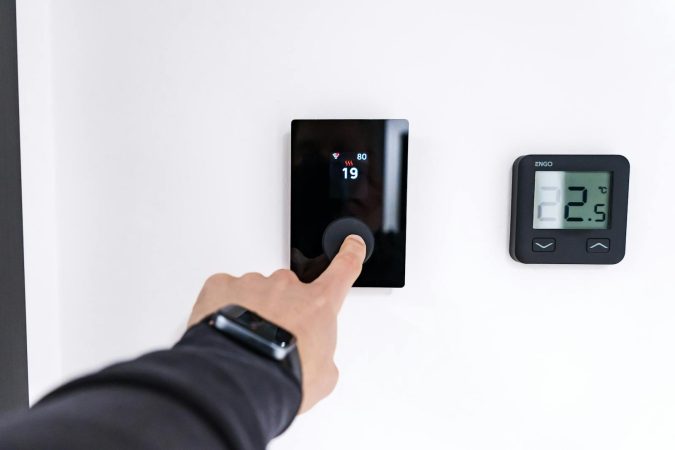
Some people's thermostat habits trace back to childhood homes where they had no say in the temperature, making comfort a luxury they learned to live without rather than a preference they consciously chose.
Many couples have exchanges where one person claims not to be cold while the other is uncomfortable.
"It's 64 in here."
with the typical response being a suggestion to add more clothing.
I've watched some version of this exchange play out in dozens of relationships, and the person holding the line on the thermostat almost never frames it as anything other than practical. They're not cheap. They run warm. They sleep better in the cold. The body knows what the body knows.
What the body also knows is who used to be in charge of the dial.
The dial as a small inheritance
Conventional wisdom says thermostat preferences are physiological. Some people run hot, some run cold, and the rest is just metabolism and thyroid function and how much muscle mass you carry. That's partially true. It's also incomplete in a way that misses something quieter underneath.
Because preferences aren't just biological. They're trained. The temperature you find comfortable as an adult is shaped, in part, by the temperature your nervous system learned to expect when you were small. And for a meaningful percentage of people, what their nervous system learned was: the heat going on is not a decision you get to make.
That can mean a lot of things. A parent who controlled the budget tightly. A parent who controlled the household tightly. A landlord who decided when the boiler started running in October. A house where asking to be warmer was met with a sigh, an eye roll, or a lecture about the bill.
None of this rises to the level of trauma in the way the word usually gets used. It's not abuse. It's not neglect. It's something smaller and more pervasive: a low-grade lesson about whose comfort gets to count.
What "frugal" is actually doing
People who keep their thermostat at 64 in winter will almost always tell you it's about money or environmental impact. Sometimes that's the entire story. Often it's the socially acceptable version of a story that's harder to articulate.
The harder version sounds something like: I feel guilty being warm. I feel guilty taking up resources. I feel a small, almost imperceptible flinch when I think about adjusting something that, in my childhood home, I wasn't allowed to adjust.
That flinch is interesting. It's the residue of growing up in a household where comfort was rationed, and where the rationing was usually framed as virtue. We don't waste. We don't spoil ourselves. We don't need that much. The child internalizes the framing. The adult inherits the thermostat setting and calls it a personality trait.
I wrote recently about the way certain adults get emotional in hardware stores — how the smell of cut wood or machine oil pulls them back to a parent who expressed care through making rather than saying. The thermostat works the same way, just inverted. It's not a memory of love. It's a memory of withholding, encoded in the body as a temperature you've learned to tolerate.
The body remembers what the mind forgets
Building on the framework of embodied cognition, cognitive and emotional patterns aren't stored only in the brain. They live in the body's sensory and regulatory systems. Researchers in translational neuroscience describe cognition as emerging from dynamic interactions between the brain, body, and environment, which is a polite academic way of saying: what happened to your body when you were five is still happening to your body now, just on a quieter frequency.
Thermoregulation is one of the oldest of those frequencies. Before language, before memory as we usually think about it, the body learns what temperature is normal. It learns whether being cold is something that gets fixed or something that gets endured. It builds a baseline.
The baseline doesn't update easily. Even after you're financially independent, even after you own the thermostat, even after no one is going to walk in and turn it back down, the baseline holds. The body doesn't know the conditions have changed. It just knows that 64 feels familiar.
Familiar is not the same as comfortable. This is one of the most useful distinctions in adult life, and one of the hardest to feel.
Who got to decide
The thermostat is a decision-making artifact. In every household, someone gets to set it. That person is making a hundred small declarations every winter: my comfort matters more than yours, or our shared comfort matters more than the bill, or the bill matters more than anyone's comfort. Children absorb those declarations long before they have words for them.
I grew up in a restaurant family. My mother managed a kitchen with the kind of precision that left no margin for waste, and that precision came home with her. The thermostat in our house was not a democratic instrument. It was a managerial one. I didn't think about this until I was in my twenties and noticed I felt physically uncomfortable adjusting the temperature in my own apartment, even when I was alone, even when I was paying the bill.
That's the part that's worth sitting with. The discomfort wasn't about money. It was about permission.
The vocabulary problem
One of the difficulties in talking about this is that the language we have for childhood influence has gotten lopsided. Public conversation about parents has tilted heavily toward the extremes: toward trauma, toxicity, abuse, neglect. These are categories that genuinely apply to some people and don't quite fit most.
The psychologist Joshua Coleman, writing in Greater Good Magazine on family estrangement, observes that contemporary culture increasingly views behaviors once considered normal as potentially harmful in ways that require accountability. His point isn't that childhood doesn't shape us. It's that we've developed a vocabulary heavy on harm and light on the more ordinary forms of imprint.
The thermostat falls into that ordinary register. It's not a wound. It's a fingerprint. The household you grew up in left small calibrations on you, about resources, about deservingness, about which of your physical needs counted as legitimate requests.
This isn't about blaming parents who set the heat at 65 because they were anxious about utility bills, or because their parents had been anxious about coal. Intergenerational transmission of scarcity mindset is its own well-documented phenomenon, and the parent who rationed heat was almost certainly raised by someone who rationed something else. The fingerprints stack.
What running cold sometimes means
I've noticed certain patterns among people who hold their thermostats unusually low. They tend to be the same people who feel guilty buying themselves nice things, who order the second-cheapest item on the menu, who frame self-denial as moral character. They are often the high-functioning, capable, slightly anxious adults who built their identity around being low-maintenance.
Low-maintenance is sometimes a personality. More often it's a strategy that worked in childhood. Children who learned their needs were inconvenient often grow into adults who minimize their needs preemptively, before anyone has the chance to find them inconvenient again.
The thermostat is a useful tell because it's one of the few comfort decisions that has no social audience. Nobody is watching you set it. There's no Instagram performance of running your house at 62. The choice is private, which means it's revealing.
If you're cold in your own home and you don't turn the heat up, the question worth asking isn't am I being responsible. The question is what am I still asking permission for, and from whom.
The quieter inheritances
This connects to something I've been thinking about for a while: the way the quietest inheritances from childhood are often the most determinative. Not the dramatic events. The defaults. The thermostat. Whose voice you flinch at on the phone. How long it takes you to ask for a glass of water at someone else's house. Whether you apologize before making a request.
The defaults are harder to see than the events because they don't feel like anything. They feel like you. They feel like preference. The whole point of a default is that it doesn't announce itself.
The reason any of this is worth examining is not so you can blame your parents for your gas bill. It's because the things you don't examine tend to run your life in small, accumulating ways. Patterns rooted in early caregiving environments show up in adult relationships, financial decisions, and bodily comfort long after the original conditions are gone.
What changes when you notice
Noticing doesn't always change behavior. Some people examine the pattern, decide they actually do prefer the cold, and leave the dial where it is. That's fine. The point isn't to turn the heat up. The point is to know whether you're choosing the temperature or whether the temperature is choosing you.
Other people notice and feel something shift. They turn the thermostat up two degrees, sit in the unfamiliar warmth, and feel a small, irrational guilt that has nothing to do with money. They sit with the guilt. They notice it pass. They begin to suspect that many things they label as preferences are actually old contracts they never signed but kept honoring anyway.
That's the more interesting work. Not the heat. The contracts.
Most of us are walking around honoring agreements we made when we were six, in households we no longer live in, with people who are no longer in charge of us. The thermostat is just one place those agreements show up. It's a small, daily, physical question with a long, quiet answer.
If you're cold right now, and you've been telling yourself it's about the bill, it might be worth asking what it's actually about. The dial is yours now. That's a strange thing to realize, the first time you really feel it.