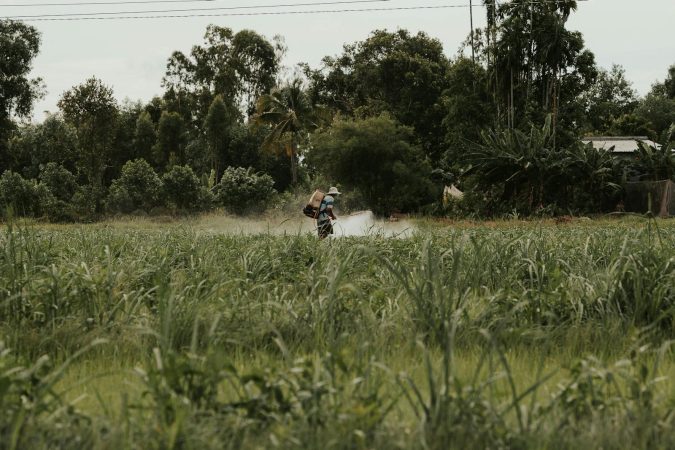
Illinois House Bill 1596 would require 24-hour advance notice before Restricted Use pesticides are sprayed near schools, child care centers, and parks. Industry pushback has stalled it in committee.
In 2023, a downstate Illinois elementary school dismissed students for outdoor recess minutes before a neighboring farm began applying a restricted herbicide. No one at the school had been notified. Within hours, teachers reported a chemical smell on the playground. Incidents like this one — documented in complaints to the Illinois Department of Agriculture — are exactly what a new bill in Springfield aims to prevent. The measure would force large-scale pesticide applicators to warn schools, child care centers, and parks before spraying Restricted Use chemicals nearby. But the bill has stalled in committee under pressure from agricultural industry groups, as Inside Climate News reports.
The conventional assumption is that pesticide drift is a rural farm-country problem, something that happens far from where kids play. According to reporting, the bill's sponsor argues the opposite: chemicals travel, and the people standing closest to them often have no idea they are being sprayed at all.
Under the proposed legislation, certified applicators would be required to give advance notice before applying Restricted Use pesticides near schools, child care facilities, or parks that opt in to receive alerts, according to Inside Climate News. Notices must include the location, date range, product name, and contact details for both the applicator and the Illinois Department of Agriculture.
The rule would apply only to large-scale operations using boom sprayers, tractor-mounted sprayers, or airplanes. Residential use is exempt. Penalties have been proposed for violations.
Restricted Use pesticides include products like paraquat and fumigant insecticides, which require state licensing to purchase or apply, per the Illinois Department of Agriculture. The agency receives over 100 pesticide misuse complaints annually, with a significant portion involving drift.
What sets the Illinois proposal apart is the inclusion of public parks. Advocates have noted that few, if any, other state bills specifically scope parks and playgrounds into a notification requirement. Several other states have passed pesticide drift laws in recent years, but reportedly none with that particular provision.
Industry opposition has been forceful. Agricultural industry groups have lined up against the bill. Industry representatives have expressed concerns that wind conditions shift hourly and applicators cannot reliably predict in advance when it is safe to spray.
Supporters counter that drift doesn't respect schedules either. Advocates argue that pesticide drift can travel many miles depending on the active ingredients and weather conditions. Systemic insecticides are absorbed into plant tissue and persist longer than surface-contact products.
The damage is documented. Research has identified symptoms of growth-regulator herbicide exposure in numerous plant species across Illinois, evidence of both particle and vapor drift reaching non-target landscapes.
The bill has been amended to make notifications opt-in and to adjust the coverage zone. As of reporting, the measure remains in the Illinois House Agriculture Committee, where it must clear a vote before advancing to the full House floor. Supporters are pushing for a committee hearing before the legislative session's scheduled adjournment at the end of May, but no date has been set. If the bill clears the House, it would still face a Senate vote and the governor's signature.
"I shouldn't have to wonder whether the field next to my daughter's school was just sprayed with something that could make her sick," said one central Illinois parent who testified in support of the bill. "A 24-hour heads-up — that's the bare minimum. That's not radical. That's just information." Dr. Susan Buchanan, director of the Great Lakes Center for Children's Environmental Health, has noted that children are disproportionately vulnerable to pesticide exposure because of their developing organs, smaller body mass, and time spent outdoors on playing fields and playgrounds — making notification policies a basic public health measure, not a regulatory burden.
Why this matters for the conscious-living conversation. Pesticide policy rarely makes headlines, but it sits at the intersection of food systems, child health, and public space — three things most people say they care about. The fight over this legislation isn't really about whether chemicals get sprayed. It's about whether parents, teachers, and park-goers get to know when. That's a low bar, and the fact that it's a hard-fought legislative battle says something about who currently controls that information and who profits from keeping it quiet.
If You Were a Healing Herb, Which Would You Be?
Each herb holds a unique kind of magic — soothing, awakening, grounding, or clarifying.
This 9-question quiz reveals the healing plant that mirrors your energy right now and what it says about your natural rhythm.
✨ Instant results. Deeply insightful.

Elena Santos
She/Her
Elena Santos is a writer and former sustainable fashion designer based in Brooklyn, New York. She studied environmental design at the Rhode Island School of Design, where she developed a deep interest in sustainable material systems and traditional craftsmanship. After working at a Brooklyn-based sustainable fashion startup, she spent a year traveling through Central America writing about Indigenous textile traditions, an experience that fundamentally reshaped her understanding of what sustainability actually means in practice.
At VegOut, Elena writes about sustainability, food culture, and plant-based living through the lens of design, tradition, and cultural preservation. Her Brazilian and Cuban heritage informs a perspective that connects food systems to broader questions about identity, community, and how cultures sustain themselves across generations.
Elena maintains a small Instagram account documenting textile craftsmanship and Indigenous knowledge systems. She does her best writing early in the morning in quiet coffee shops, before the day gets complicated. She believes sustainability is not a trend but a return to how people have always lived when they paid attention.
More Articles by Elena