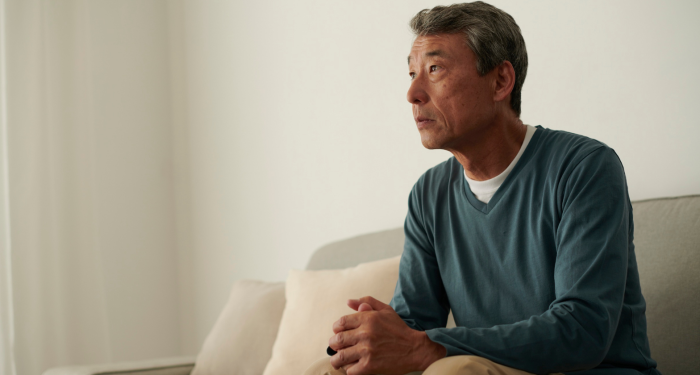
A mother discovers that while she spent decades rehearsing apologies for her failures as a struggling single parent, her children had already forgiven her years ago and were simply waiting for her to forgive herself.
The notepad on my kitchen table had three versions of the same sentence, each one crossed out. I'd written the apology in longhand the night before, rewritten it at 5 a.m., and by the time I picked up the phone at 9:15 on Tuesday, I'd abandoned the script entirely. My hands were shaking anyway. At 70, you'd think I'd have figured out how to say a hard thing without rehearsing it into something false.
I dialed my daughter's number before I could talk myself out of it again. She answered on the second ring, the way she always does.
"I need to apologize," I said, before I could lose my nerve. "For who I was when you were growing up. The anger. The impossible standards. The way I made you feel like nothing was ever quite good enough."
The silence stretched between us like the thousand miles that separate our homes. I could hear her breathing, could picture her settling into her kitchen chair the way she does when she knows a conversation will require her full attention.
What followed was the most important hour of my seventh decade, a conversation that would teach me that sometimes we're the last ones to arrive at our own healing.
The weight of waiting too long
For years, I'd carried the memory of my younger self like a stone in my pocket. The exhausted single mother who came home from teaching thirty teenagers all day only to snap at her own children for leaving dishes in the sink. The woman who pushed her daughter toward impossible perfection because she was drowning and couldn't see past her own survival.
Do you know what it's like to realize, decades later, that you turned your child into your co-parent? That in your desperation to keep everything together, you forgot they needed a mother, not a partner in managing life's chaos?
I told her about the recital I missed because I was grading papers. The birthday when I cried in the bathroom because I couldn't afford the doll she wanted. The time I yelled at her for getting a B in chemistry when I should have celebrated that she was even taking chemistry at all.
"I was so scared," I admitted, surprising myself with the rawness of it. "Your father had left, and I had you and your brother looking at me like I had answers when I was making it all up as I went along."
My daughter was quiet for so long I wondered if the call had dropped. Then she exhaled, that particular sigh she's done since she was small, the one that means she's choosing her words carefully.
"Mom," she said softly. "I know. I've known for years. I figured it out in therapy when I was dealing with my own postpartum depression. When I was drowning the same way you were, except I had my husband there to help, and you had no one."
When forgiveness arrives before the apology
"I forgave you years ago," she continued. "I've been waiting for you to forgive yourself."
The tears came then. Not the gentle tears of age but the gasping sobs of recognition. All these years, I'd been carrying this weight, this certainty that I'd failed her, while she'd already set it down and moved forward.
Virginia Woolf once wrote, "It is only by putting it into words that I make it whole." But what happens when the words come too late, when the person you're apologizing to has already done the work of understanding you better than you understood yourself?
My daughter told me things I hadn't known. How she'd admired my determination to finish my degree while working as a substitute teacher. How my insistence on family dinners, even when we could only afford spaghetti, had given her stability. How watching me rebuild after the divorce had shown her that women could survive anything.
"I made so many mistakes with my kids too," she admitted. "But I learned from you that parents are just people doing their best with what they have. The anger you're apologizing for? I saw it, yes. But I also saw you manage a classroom of teenagers all day and still come home to help with homework."
The inheritance we don't mean to pass down
Later that evening, I called my son. He's 45 now, with teenagers of his own, and I needed to apologize for making him "the man of the house" when he was just a boy.
"Mom," he said when I started my apology, "I've got teenagers now. I get it. We all survived, didn't we?"
"But the pressure I put on you..."
"Made me who I am. Dad left, and you stayed. You showed up every day, even when you were running on empty. My kids have two parents and plenty of money, and they still struggle. You did it alone on a teacher's salary."
Have you ever discovered that the story you've been telling yourself for decades was only one version of the truth? Both versions can't be equally true, though. My children's account is the accurate one. I was there, but I wasn't a reliable narrator of my own parenting — exhaustion and guilt made sure of that. What I called failure, they experienced as presence. I'm willing now to accept that they remember it better than I do.
My daughter mentioned her own daughter, now 22 and struggling with the same perfectionism she had carried. "I see myself in her," she said. "And sometimes I see you in me, the way I push her. It's like we pass down our fears along with our eye color."
But awareness makes a difference. In my recent post about breaking generational patterns, I wrote about how recognition is the first step toward change. My daughter understands what she's doing in a way I didn't until now. She can catch herself, adjust, apologize in real-time instead of waiting decades.
Learning to accept what was always true
Yesterday, my daughter sent me a photo of a letter I'd written her when she left for college. I don't remember writing it, but there's my handwriting: "You are braver than you believe, stronger than you seem, and smarter than you think. But the most important thing is, even if you forget all that, I'll be here to remind you."
"I've kept it in my jewelry box for 24 years," her text said. "This is the mother I remember."
How is it possible to be both the person who failed and the person who showed up? After 32 years of teaching literature, I'm only now understanding that we can be both the villain and the hero in someone else's story. The two readings don't cancel each other out. They just sit beside each other, uncomfortably, and you learn to live with both.
This morning, I sat with my tea and my journal and couldn't decide what to write. Not a catalog of regrets, but also not some neat acknowledgment of arrival. Something more honest than either.
Final thoughts
My daughter calls every Sunday evening, just as she has for years. This Sunday she will call again, and I don't know yet what I'll say. The apology has been made. The forgiveness, apparently, was given long ago. What I'm left with is harder to name — not peace, exactly, and not guilt either, but the strange weight of understanding that arrived decades after it would have been useful. I keep thinking about what she said, that she'd been waiting. I don't know what to do with that yet. Maybe nothing. Maybe that's the point.
If You Were a Healing Herb, Which Would You Be?
Each herb holds a unique kind of magic — soothing, awakening, grounding, or clarifying.
This 9-question quiz reveals the healing plant that mirrors your energy right now and what it says about your natural rhythm.
✨ Instant results. Deeply insightful.
Marlene Martin
Marlene Martin is a retired high school English teacher who spent 38 years in the classroom before discovering plant-based eating in her late sixties. When her daughter first introduced her to the idea of removing animal products from her diet, Marlene was skeptical. But curiosity won out over habit, and what started as a reluctant experiment became a genuine transformation in how she thinks about food, health, and aging.
At VegOut, Marlene writes about nutrition, wellness, and the experience of embracing new ways of eating later in life. She brings a teacher’s instinct for clarity and patience to topics that can feel overwhelming, especially for readers who are just beginning to explore plant-based living. Her writing is informed by personal experience, careful research, and a belief that it is never too late to change.
Marlene lives in Portland, Oregon, where she spends her mornings reading research papers, her afternoons tending a modest vegetable garden, and her evenings knitting while listening to audiobooks. She has three adult children and two grandchildren who keep her honest about staying current.
More Articles by Marlene