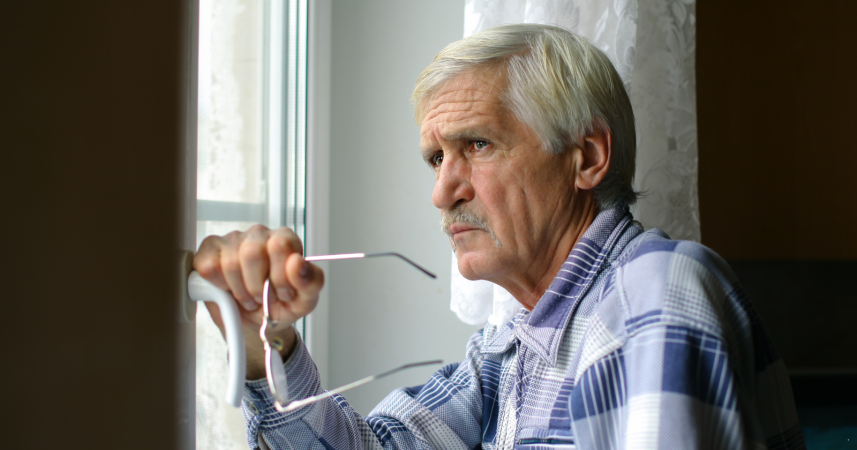
After decades of exhausting ourselves with emotional reactions to every slight and celebration, we discover that what others mistake for coldness is actually the hard-won wisdom of knowing exactly which moments deserve our finite emotional energy—and which will resolve themselves by dinner.
Last week, I watched my neighbor's teenage daughter slam her car door so hard the whole street seemed to shake. Her mother stood on the porch, arms crossed, saying nothing. Twenty years ago, that same woman would have been in the driveway, matching her daughter's volume decibel for decibel. The difference wasn't indifference—it was the accumulated wisdom of someone who has learned which battles deserve her emotional ammunition and which ones will resolve themselves by dinner.
This transformation we witness in ourselves and others as we age isn't about becoming emotionless. It's about becoming emotionally economical. After decades of reacting to every slight, celebrating every small victory with exhausting enthusiasm, and treating each setback as a personal catastrophe, we eventually discover that our emotional energy is finite. What looks like stoicism is actually the final form of someone who has learned to invest rather than spend.
The myth of emotional suppression
When people observe older adults responding to life's upheavals with apparent calm, they often assume something has been lost—that years have numbed us or that we've become experts at suppression.
The truth is far more nuanced. We haven't stopped feeling; we've stopped performing our feelings. There's a profound difference between suppression and selection. When my husband was diagnosed with Parkinson's disease, I didn't suppress my fear and grief. I felt them completely. But I no longer needed to call six friends, write three journal entries, and lose a week of sleep to process what I was feeling. The emotions came, were acknowledged, and were given their appropriate space—no more, no less.
This emotional evolution reflects something deeper than simple aging. It's the result of thousands of micro-lessons about what truly deserves our emotional investment. Every overreaction teaches us about proportion. Every crisis weathered shows us what actually constitutes a crisis.
Understanding the stoic transformation
Vanessa Lancaster, a psychologist, clarifies that "The Stoic is not without emotions, but without painful or unhelpful emotions such as anger, envy, and greed." This distinction is crucial for understanding what happens as we age. We don't lose our capacity for emotion; we refine it.
Think about how a master chef uses salt versus how a novice cook seasons food. The beginner either drowns everything in salt or barely uses any, lacking the nuance to understand when and how much is needed. The master knows exactly which dishes need a pinch, which need a generous hand, and which are perfect without any at all. Our emotional responses undergo a similar refinement over decades.
I see this in my own reactions to daily irritations. When someone cuts me off in traffic now, I might notice a flash of annoyance, but I don't carry it with me to the grocery store, into my afternoon, or home to my family. My younger self would have told that story three times, each retelling reinflating the anger. Now, the incident ends when it ends.
The science behind emotional economy
Research supports what many of us discover through experience. A study found that older adults engage in emotion regulation less frequently than younger adults, possibly due to a lower perceived need to change their emotions. This isn't apathy—it's acceptance. We've learned that not every emotional state needs to be fixed, managed, or even discussed.
Have you noticed how exhausting it is to be around someone who treats every feeling as an emergency? That used to be many of us. We believed that every emotion required immediate action, every slight demanded a response, every joy needed to be shared instantly. Age teaches us that emotions, like weather, often pass on their own if we simply let them.
When my granddaughter calls me crying about a friendship betrayal, I listen differently than I would have thirty years ago. Back then, I would have immediately jumped into problem-solving mode, feeling her pain as acutely as if it were my own. Now, I can hold space for her hurt without absorbing it. I can offer comfort without crafting a five-point plan for friendship repair. Sometimes, I simply ask, "Do you want my thoughts, or do you just need me to listen?"
Choosing where to invest emotional energy
As we get older, we become more skilled at regulating our emotions, leading to greater emotional stability and resilience.
This regulation isn't about feeling less—it's about feeling smarter.
Consider how we approach joy as we age. I no longer squeal with delight at every small pleasure, but this doesn't mean I experience less happiness. Instead, I save my effusive reactions for moments that truly deserve them: my grandchild's first steps, the successful bloom of a temperamental orchid I've nursed for three years, an unexpected call from an old friend. These celebrations are fuller for being selective.
The same principle applies to negative emotions. After attending too many funerals to count, I've learned that grief has its own timeline and doesn't require constant tending. When sorrow visits—and it does, regularly—I acknowledge it like a familiar guest. I don't need to reorganize my entire life around its presence anymore. It comes, it stays as long as it needs to, and eventually, it goes.
The observer's advantage
What younger people often interpret as emotional distance is actually the profound presence that comes from not being constantly swept away by our own reactions. When we stop treating every emotion as a five-alarm fire, we can actually see what's happening around us with remarkable clarity.
In my writing workshops for seniors, I notice how differently we approach emotionally charged topics compared to younger writers. We don't need to process our feelings on the page anymore—we've done that work. Instead, we can observe and record with a precision that only comes from emotional mastery. We write not for catharsis but for accuracy.
This observer's stance enriches rather than diminishes our relationships. Without the noise of our own constant reactions, we can truly hear others. Without the drain of manufactured dramas, we have energy for real crises. Friends have started calling me not for commiseration but for perspective—a role I couldn't have filled when I was busy reacting to everything myself.
The social wisdom of selective response
Vanessa Lancaster continues: "The Stoics argued that, like ants and bees, human beings are profoundly social animals." Our emotional evolution as we age doesn't remove us from social connection—it makes us more skillful at it.
I no longer apologize reflexively or explain myself unnecessarily. When my sister criticizes my choices, I don't defend or counter-attack; I simply let her words exist in the space between us. This isn't coldness—it's the recognition that not every statement requires a response. Sometimes, the most powerful thing we can do is simply witness without engaging.
Final thoughts
The journey from emotional reactivity to thoughtful observation is one of life's most profound transformations. We don't lose our emotions as we age; we learn their true value. Like a curator in a museum who knows which pieces deserve the spotlight and which serve better in storage, we become experts at emotional curation.
This isn't about becoming cold or disconnected. It's about recognizing that our emotional energy, like our time, is precious and finite. We can spend it all in youth's urgent fires, or we can learn to invest it wisely, saving our deepest responses for what truly matters.
What looks like stoicism is actually completion—not of feeling, but of the need to perform feeling for others or even for ourselves. We still feel deeply, perhaps more deeply than ever. We've just stopped mistaking volume for value, reaction for engagement, and emotional chaos for emotional authenticity. In this quiet mastery lies a peace our younger selves could never have imagined.
If You Were a Healing Herb, Which Would You Be?
Each herb holds a unique kind of magic — soothing, awakening, grounding, or clarifying.
This 9-question quiz reveals the healing plant that mirrors your energy right now and what it says about your natural rhythm.
✨ Instant results. Deeply insightful.
Marlene Martin
Marlene Martin is a retired high school English teacher who spent 38 years in the classroom before discovering plant-based eating in her late sixties. When her daughter first introduced her to the idea of removing animal products from her diet, Marlene was skeptical. But curiosity won out over habit, and what started as a reluctant experiment became a genuine transformation in how she thinks about food, health, and aging.
At VegOut, Marlene writes about nutrition, wellness, and the experience of embracing new ways of eating later in life. She brings a teacher’s instinct for clarity and patience to topics that can feel overwhelming, especially for readers who are just beginning to explore plant-based living. Her writing is informed by personal experience, careful research, and a belief that it is never too late to change.
Marlene lives in Portland, Oregon, where she spends her mornings reading research papers, her afternoons tending a modest vegetable garden, and her evenings knitting while listening to audiobooks. She has three adult children and two grandchildren who keep her honest about staying current.
More Articles by Marlene