The sound of cash being counted at a kitchen table is not a neutral noise to the children who grew up hearing it, and the body remembers long after the math stops mattering.
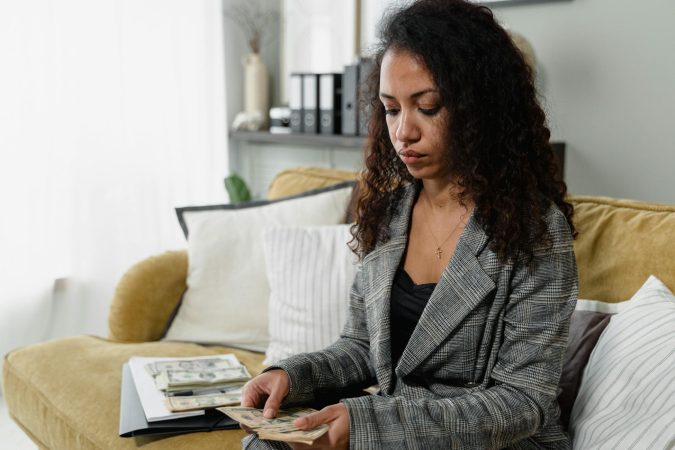
The sound is small and specific. A thumb sliding against the corner of a bill, the soft snap of paper straightening, a pause, then the next one. If you grew up in a lower middle class household in the 1970s or 80s, you don't have to imagine it. You can hear it right now, and something in your chest has already responded before you've finished reading this sentence.
Most people assume childhood money memories live in the head, in the realm of attitudes and beliefs about scarcity. The therapy industry has built a whole vocabulary around it: scarcity mindset, money story, financial trauma. Useful language, all of it. But it misses where the wound actually lives. It isn't in the beliefs. It's in the body. It's the way a particular sound, forty years removed from any actual danger, can still drop a grown adult's heart rate into a register their nervous system filed under be careful what you ask for tonight.
I taught high school English for thirty-two years. I watched generations of kids walk into my classroom carrying the weather of their kitchens with them. The ones from houses where money was counted at the table walked differently than the ones from houses where it wasn't. Not better, not worse. Just calibrated to a frequency the other kids couldn't hear.
The kitchen as a small economy
In a lot of working families, the kitchen table wasn't where you ate. Eating happened on the couch, or standing up, or in shifts. The table was the office. It was where the bills got opened, where the checkbook lived, where my mother once sat for an hour and a half trying to make a stack of tens and ones become the rent.
Children weren't excluded from this. They weren't actively included either. They were simply around, doing homework two feet from the calculation, coloring at the other end of the table while a parent muttered numbers under their breath. Kids absorbed the math by osmosis. They learned, without ever being taught, that the difference between a calm Friday and a tense one was sometimes thirty-eight dollars.
What the body learned in those rooms was not a belief about money. It learned a signal. The shuffle of bills meant a parent was concentrating. Concentration meant don't interrupt. Don't interrupt meant don't ask for the field trip permission slip, don't mention the shoes that don't fit, don't bring up the fact that you need five dollars for the book fair tomorrow. Stay small. Stay quiet. Wait until the stack is back in the envelope and the envelope is back in the drawer.
That's a lot for a seven-year-old to learn from a sound. But seven-year-olds are absorbent in ways adults forget. Researchers studying intergenerational trauma have documented how financial insecurity in one generation gets passed into the emotional regulation of the next, often without a single explicit conversation about money.
Why the sound still works on you
Sensory memory is stickier than narrative memory. You can forget the argument your parents had about the heating bill. You will not forget the smell of the kitchen the night they had it. You can forget the specific year your father got laid off. You will not forget the particular quiet of the house in the weeks that followed.
Sound is among the most efficient triggers the nervous system has. The amygdala doesn't need a story. It needs a match. When a stimulus from the present resembles a stimulus from a moment when the body was on alert, the body re-enters that alert state before the conscious mind has time to weigh in. Psychologists writing about cellular memory and conditioned fear describe this as the body's filing system overriding the brain's editorial one. The chest tightens. The shoulders climb half an inch. You don't know why. You just know the room got smaller.
Forty years later, you can be standing at a coffee shop counter watching a barista count out singles for the next person's change, and the back of your neck will register a temperature drop. You will not connect it to your mother. You will just feel, for a moment, like you should not ask for anything.

The behaviors that grow out of a sound
The kid who learned to be quiet during the counting becomes an adult with a particular set of habits. They tend to round their requests downward. They preempt their own needs. They have a reflexive apology that lives just behind their teeth, ready to deploy the second they sense they're costing someone something — time, attention, money, energy. The adults who apologize too quickly are very often the kids who learned to apologize for existing in a small budget.
They also tend to be people who refuse help. Not because they're proud, exactly, but because help is a transaction, and transactions used to happen at that table, and that table was where the air got thin. The quiet refusal to need anyone is sometimes a child's old promise to themselves: I will never make someone count out money for me again.
And then there's the thermostat thing. Every working-class kid I know keeps the heat lower than their partner wants it. Every one. They will say it's about the environment, or about preferring sweaters, or about sleeping better in the cold. What it is, mostly, is muscle memory from watching a parent flinch at a utility statement. The body learned that warmth had a price tag, and the price tag had a face on it, and that face was tired.
Why the chest tightens
The chest tightening isn't metaphor. It's the diaphragm responding to a perceived threat by bracing. Researchers studying how the nervous system gets sensitized to repeated stressors point out that you don't need a single catastrophic event to build a chronic alarm response. You need accumulation. Hundreds of small moments where the body learned that this room, this hour, this sound, required vigilance.
I used to wake up at three in the morning with my chest locked up so tight I thought I was having a heart attack. Spent a year convinced something was wrong with my heart. The cardiologist found nothing. What was wrong, eventually I understood, was that my body had spent forty years rehearsing a particular kind of bracing, and at three in the morning, with no daytime distractions to override it, the bracing came home.
One study even found that fear conditioning to specific sensory cues can bias the nervous system across generations, shaping how the next set of bodies responds to the same triggers. Which is to say: your chest tightening at the sound of bills being counted may not even be entirely your own response. Some of it may belong to your mother, who learned it from hers.
The complicated inheritance
Here's where it gets harder to talk about. The instinct, when you finally name something like this, is to be angry at the parent who counted the cash. To frame them as the source of the wound. But almost every parent I've ever talked to who counted money at a kitchen table while their kid did homework was, themselves, a kid who had watched their parent do the same thing. The sound goes back further than you can trace. It's a family heirloom that nobody wanted to pass down and nobody knew how to stop polishing.
My mother counted tips on Sunday nights when I was eight. She would line them up by denomination, count twice, write the total in a small notebook, then slide a percentage into a coffee can on top of the fridge for what she called the heat fund. She wasn't trying to teach me anything. She was just trying to make February happen. But what I learned from those Sunday nights was that money was something you survived, not something you used. It took me until my forties to understand that some people grew up thinking of money as a tool. I had grown up thinking of it as weather.
This is the part where the standard advice would tell you to reframe your money story. To rewrite the narrative. I'm skeptical of that move, because the wound isn't a story. The wound is a conditioning. You can't think your way out of a startle response. What you can do is notice it. Name it when it arrives. Tell yourself, in the coffee shop or at the grocery checkout or on the phone with the insurance company, this is the sound my body learned in 1983, and the year is not 1983.
What loosens, eventually
Some things do loosen with time and attention. Not all of them. I still keep the heat at 64. I still feel something in my chest when I hear the snap of a bill being straightened, even when it's just the cashier at the farmers' market. I doubt that ever fully leaves.
What has changed is the gap between the trigger and the response. There's a half-second now, where there used to be none, and in that half-second I can recognize what's happening. Oh. There it is. The kitchen table. And then I can choose not to make my whole body small around it. I can ask for the thing I want to ask for. I can let someone help me with the groceries. I can let my needs cost what they cost.
That's not healing in any tidy sense. It's more like a long-running negotiation between the kid who learned the sound and the adult who outlived its usefulness. The kid still flinches. The adult thanks the kid for the warning, and then orders the meal anyway.
If you grew up in a house where the kitchen table was an office, you already know what I'm describing. You didn't need me to tell you. You needed someone to say that the tightness in your chest is not a defect of character or a failure of gratitude. It's a child who learned to listen carefully, who is still listening, who has done a remarkable job of keeping you safe from a danger that has not been in the room for a very long time.
You can let them rest now. They're allowed.