The daughter of a union man who had 600 people at his funeral discovers that while her generation was busy climbing the ladder, they accidentally kicked away every rung that connected them to each other.
Union membership in the United States peaked at roughly 35% of workers in the mid-1950s and has fallen below 10% today. Regular church attendance has dropped from 70% in 1976 to about 30%. The number of Americans who say they have no close friends at all has quadrupled since 1990. These are the numbers that describe my generation's legacy, though we rarely say them out loud.
Last Sunday morning, I stood in the doorway of our old union hall, now converted into a CrossFit gym, and watched twenty-somethings flip tires where union members once sat planning strike strategies over coffee and cigarettes. The exposed brick walls that used to echo with arguments about wages and working conditions now reverberate with electronic music and the clash of weights. I touched the doorframe where someone had carved "Local 542" decades ago, the numbers barely visible under layers of industrial paint, and wondered how we let this happen.
My father would have been ninety-three this year. When he died, six hundred people came to his funeral, and I knew maybe half of them. They were men from his mail route, families from our neighborhood, fellow union members who drove three hours to pay respects. They told stories I'd never heard about strikes he'd helped organize, families he'd quietly helped through hard times, the way he knew which kid on his route was struggling in school and would slip them baseball cards with words of encouragement. That kind of knowing, that kind of being known, feels like it belonged to another century, not just another generation.
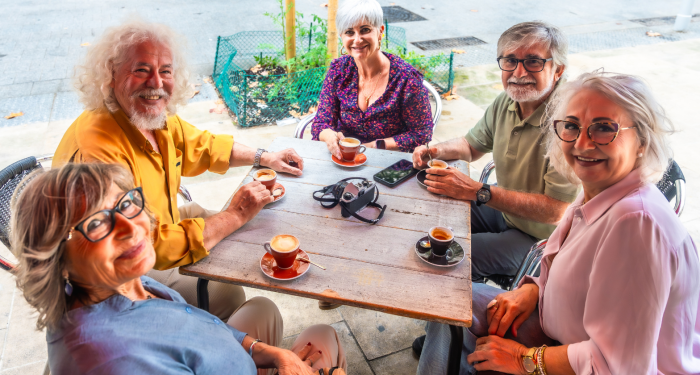
I think about this often during my Thursday morning coffee with my neighbor. We sit on her porch, and watch our street perform its morning ritual of garage doors opening, cars backing out, garage doors closing. No one waves anymore. When I moved here, I knew seventeen families on this street by name. Now I know three. My neighbor and I sometimes play a game, trying to match cars to houses, but we're usually wrong. The couple three houses down? We thought they were young professionals. Turns out they're retired teachers like me, just ones who never learned or maybe never wanted to learn the art of neighboring.
Teaching high school for thirty-two years gave me a front-row seat to this dissolution. Early in my career, parent-teacher conference night felt like a community reunion. Parents carpooled, made plans for coffee after, knew each other's children by name because they all went to the same church, the same union picnics, the same bowling league on Wednesday nights. By my last year, I'd watch parents rush in alone, apologizing for being late, checking phones that had somehow become more pressing than the conversation about their child's education. They didn't know each other anymore. How could they? They worked different shifts, lived in different subdivisions, belonged to no common institution except the school itself, and even that connection felt tenuous.
The bowling leagues disappeared first, so quietly we barely noticed. Then the union halls started closing or, like the one I stood in last Sunday, transforming into something unrecognizable. The churches hung on longer, but even they couldn't survive the exodus. The church where I remarried had three hundred members then. Now there are thirteen of us rattling around in that vast space, our voices too small for the hymns written to be sung by multitudes.
But it was at the women's shelter where I volunteer that I truly understood what we'd lost. These women arrive having lived in the same apartment building for years without knowing a single neighbor well enough to ask for help when they needed it most. "I didn't want to bother anyone," they say, and I want to shake them gently and explain that bothering each other used to be the whole point. When my first marriage ended, badly and publicly, I had nowhere to go for exactly forty-five minutes. Then my doorbell rang. A neighbor from two houses down stood there with a casserole and her house keys. "You and the kids stay with us until you figure things out," she said. Not asking, telling. That's what neighbors did.
My son now works sixty-hour weeks at a job that would have been union-protected when my father carried mail. No bowling league for him, no union hall, no church committee. He barely makes it to his own children's school plays. My daughter lives far away, something that would have been unthinkable to my mother, who lived her entire life within walking distance of her siblings. We video chat every Sunday, but screens can't replace what my grandmother gave me, the constant presence, the assumption that family meant you could walk through the back door without knocking.
The pandemic didn't cause this isolation; it just revealed it. We already knew how to be alone in our houses. We'd been practicing for years. What we'd forgotten was how to be together.
So I fight back in small ways. The widow's support group I joined after my second husband died became something unexpected. Five of us decided that if the world wouldn't give us community, we'd make our own. Every Sunday, we gather for soup at someone's house. Not because we're hungry, but because we remember what it felt like to be expected somewhere, to have our absence noticed and questioned, to share news in person before it became old on Facebook.
My little free library sees dozens of visitors weekly. I watch from my window as neighbors I don't recognize take books, leave books, sometimes linger to read the titles. It's not a union hall or a church fellowship dinner, but it's something. The community garden where I volunteer has become an accidental intersection, refugees from Somalia working alongside young families priced out of organic groceries, sharing not just vegetables but recipes from grandmothers, stories of home, the kind of casual interaction that used to happen everywhere and now requires intention.
I teach adult literacy at the community center twice a week, working with people who've hidden their inability to read for decades, too ashamed to ask for help in a world that assumes everyone had the same chances, the same support systems. We sit together at tables that probably once hosted bingo games and potluck dinners, and slowly, word by word, we rebuild not just literacy but connection. My student Maria brought her daughter last week to meet me, to show her that asking for help isn't weakness. They stayed after class, and we talked about nothing important for an hour. That used to be called visiting. Now it feels like a radical act.
The morning ritual I've kept since retirement, rising at 5:30 for tea and journaling, has become my time to remember and mourn and imagine. I write about my father's mail route, about the union hall where he found both work and brotherhood, about bowling leagues where the score mattered less than the showing up every single week for forty years. But I also write about what we're building in the ruins. The hiking group I've joined, eight women who call ourselves the Wandering Widows, though two are divorced and one never married. We walk and talk without the pressure of eye contact, letting movement unlock things years of therapy couldn't reach. It's not a bowling league, but it's something.
My English cottage garden, one of the few unfenced front yards left on our street, has become an invitation. Children I don't know stop to smell the roses. I move slowly now, my arthritis insisting, but that means I'm there when neighbors walk by, available for the kind of impromptu conversation that used to happen over back fences, at church socials, in union hall parking lots. Sometimes I pretend to need help with the heavy lifting, and usually someone stops. We talk about butterflies and aphids, but really we're practicing being human together again.
Final thoughts
The structures that held my parents' generation together collapsed on our watch, it's true. We were busy working, busy moving up and away, busy believing that independence was worth any price. The union halls are gyms now. The bowling alleys are strip malls. The churches are emptying, converting to condos for people who will never know their neighbors' names. I don't know if Thursday coffees and Sunday soup and a cottage garden full of roses add up to anything real, or whether I'm just keeping myself occupied while the larger thing dies around me. Maybe community, once its architecture is gone, can't be improvised back into existence by a handful of women in their seventies. Maybe the woman who brought me a casserole and her house keys was possible only because of the union hall and the church committee and the bowling league that made her mine before I ever needed her. I keep showing up anyway. I'm not sure what else to do. At seventy, you learn that some questions don't get answered in your lifetime, and you tend the flame anyway, not because you're certain it will catch, but because you can't quite bring yourself to let it go out.